


Page 69 - 2018 NOV/DEC Outdoor Oklahoma
P. 69
But we also add color bands that denote the year the bird
          was hatched. This lets us visually track the birds as they   Century-old McCurtain
          mature  and  hopefully  establish  new  territories  on  the   Wilderness Benefits Larger
          wilderness area.”
            Extracting the week-old chicks from their nest cavity  Wildlife Community
          can be difficult. It also requires perfect timing. Before
          handling the chicks, biologists coat their hands in corn-  With the creation of the McCurtain County
          starch so that oils from their skin aren’t transferred to   Wilderness  Area  in  October  1918,  the  Oklahoma
          the mostly naked chicks. This year, 16 nestlings were   Department of Wildlife Conservation invested in a
          banded and returned to their nest cavities.         legacy of  land  management  that  continues  today.
                                                              The state’s first management area, 14,087 acres in
          Fall: Habitat Maintenance                           far southeastern Oklahoma, stands out as the larg-
            Once the chicks were banded, Barnes and Shope     est remaining patch of mature shortleaf pine-hard-
          turned their attention to habitat and cavity maintenance.   wood forest in the nation.
                                                                Towering pines mingle with a variety of oaks and
          Supplemental cavity inserts were placed to help birds   other hardwoods on the area’s sometime steep
          overcome the labor-intensive challenge of drilling a cav-  slopes.  Grasses  and  wildflowers  flourish  under-
          ity. Metal restrictors were added to natural cavities so   neath  the  lofty  giants.  This  open,  park-like  scene,
          that the entrance holes wouldn’t be expanded by other   reminiscent of the southern forest’s historical condi-
          woodpecker species. And southern flying squirrels and   tion, is favored habitat for the federally endangered
          red wasps were evicted from cavities so the endangered   red-cockaded woodpecker. And while this wood-
          woodpecker could continue to persist on the area.   pecker’s life cycle shapes much of the Department’s
            Beyond cavity tree maintenance, the management
          team also works year-round to maintain the open for-  workload in this wilderness area, the management
                                                              team knows woodpeckers aren’t the only beneficia-
          est conditions the birds require. Luckily, the wilderness   ries of their daily efforts.
          area’s largest neighbor is the U.S. Forest Service, and   “When we provide habitat for the woodpeckers,
          both agencies share management goals, and in some   we’re providing habitat for a number of other spe-
          cases, resources.                                   cies, from insects to game birds like turkey and quail,
            “Partnering with the U.S. Forest Service allows us
          to provide three and a half times more habitat for the   to  larger  mammals  like  deer,”  said  Clay  Barnes,  a
                                                              wildlife  biologist  for  the  Wildlife  Department  who
          red-cockaded woodpecker, and really for a broader wild-  oversees the area. “So many species are thriving
          life community,” Barnes said. “You can really see a differ-  under the umbrella of woodpecker management.”
          ence where we’ve focused management efforts. It really   After years of active management, biologists and
          gives the area life.”
                                                              hunters have noticed an increase in the area’s wild-
                                                              life. “Surveys have shown a positive response in
          CLAY BARNES/ODWC                                    many songbirds. And deer and turkey hunters reg-
                                                              ularly observe and harvest their game as part of the
                                                              area’s limited controlled hunts program.
                                                                So what’s in the recipe that creates the open habitat
                                                              and resulting wildlife boost? Biologists such as Barnes
                                                              and his predecessors have been applying prescribed
                                                              fire across the area on a three-year rotation.
                                                                “We  know  the  area  has  had  a  long  fire  history,
                                                              both from natural lightning fires and man-made fires
                                                              started by Native Americans. We’re just continuing
                                                              that history.”
                                                                Users may experience the open forests and
                                                              local  wildlife  with  a  visit  to  the  McCurtain  County
                                                              Wilderness Area’s nature trail, on the area’s western
                                                              unit.  Hiking  and  backpacking  permits  for  the  area
                                                              east of Broken Bow Lake may be secured by con-
                                                              tacting the area’s biologist at least two weeks before
                                                              planned arrival.
                                                                All visitors are required to possess a conservation
                                                              passport or valid Oklahoma hunting or fishing license
                                                              to enter the management area.
                                                                                               — Jena Donnell
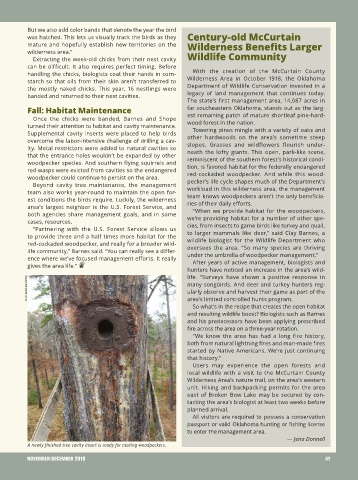
          A newly finished tree cavity insert is ready for nesting woodpeckers.

          NOVEMBER/DECEMBER 2018                                                                           41

