Wetland in a Box
Jena Donnell
Welcome to the Wetland
What are wetlands?
Simply put, wetlands are areas where water covers the soil or is near the soil surface either year-round or at various times of the year. Water saturation is the key factor in determining how the soils develop and what plant and animal communities are present. In Oklahoma, wetlands are typically shallow and may completely dry during some seasons.
They are often created in transitional zones between upland habitats (grasslands and forests) and aquatic habitats (rivers and streams) but are also common in “low-spots” where surface water accumulates or groundwater discharges to the surface for at least a portion of the growing season.
Wetlands have many functions. They can support a wide variety of biodiversity and have even been referenced as “ecological supermarkets.” Amphibians, reptiles, shorebirds, waterfowl, songbirds, mammals, fish, and insects may utilize wetlands for food, reproduction, or at different times in their lifecycle. Wetlands can also clean polluted water, recharge ground water, and store water to reduce the impacts of flood events.
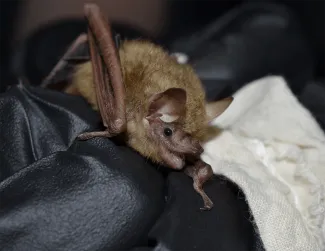
Oklahoma's Bats
Oklahoma has 23 bat species, including the little brown bat (skull) and the American perimyotis (photo).
Bats are the only mammals capable of flight.
Oklahoma’s bats are insectivores and feed on invertebrates.
During their active season, some species may forage for insects over Oklahoma’s wetlands.
During winter, Oklahoma’s bats must either hibernate or migrate.
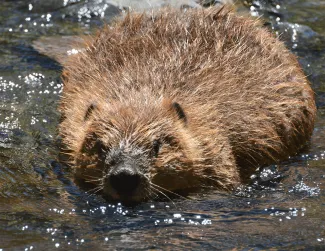
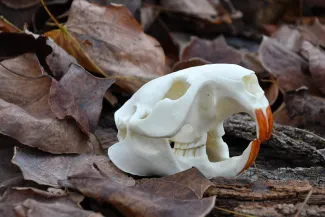
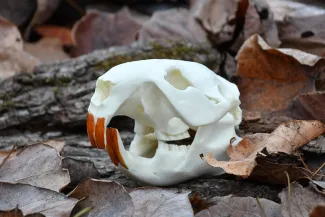
AMERICAN BEAVER
The beaver is Oklahoma’s largest rodent.
Beavers can use their large teeth to fell trees. Like other rodents, these teeth continue to grow throughout the animal’s life but are worn down with use.
Beavers feed on the inner bark of trees and on twigs, as well as other vegetation.
This species has several adaptations for an aquatic life: a paddle-like tail; large, webbed hind feet; the nostrils and ears can be sealed while underwater; and a nictating membrane covers the eyes while underwater.
In Oklahoma, beavers typically build burrows in the banks of streams and rivers.
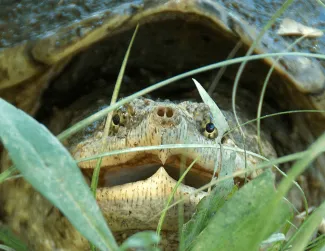
COMMON SNAPPING TURTLE
The common snapping turtle can be found statewide.
These turtles are omnivores and eat a wide variety of foods including carrion, plants, aquatic invertebrates, fish, reptiles and even birds and mammals.
Common snapping turtles are most often mistaken as alligator snapping turtles. Common snapping turtles are smaller in size, have saw-tooth projections on the tail (alligator snapping turtles have a smooth tail) and a less-pronounced hooked beak.
The gender of these turtles (and many others) is often determined by the temperature of the nest. Warmer nests tend to produce more females.
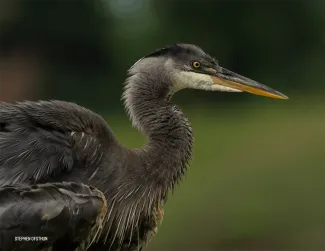
GREAT BLUE HERON
The great blue heron is the largest heron in the U.S. and one of the most widespread wading birds in the country. In Oklahoma, it can be found statewide.
These large birds fold their neck in an s-shape and keep the long legs extended while in flight.
Great blue herons feed primarily on fish, but will also eat amphibians, reptiles, invertebrates, mammals, and other birds.
They often wade into water and wait for their prey.
This bird typically builds nests in trees and may form large nesting colonies. 2-6 pale blue eggs are laid in the stick nest and are incubated for nearly one month. Chicks remain in the nest for another 2-3 months.
Stephen Ofsthun
Skull Photos
Image
Beaver Skull
Image
Beaver Skull
Image
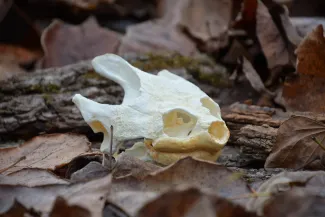
Common Snapping Turtle Skull
Image
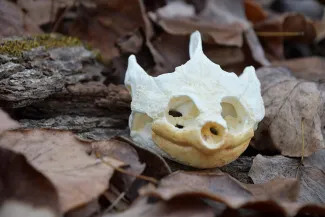
Common Snapping Turtle Skull
Image
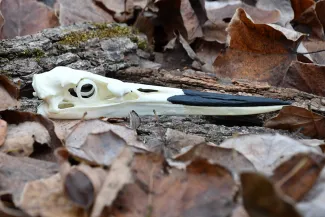
Great Blue Heron Skull
Image
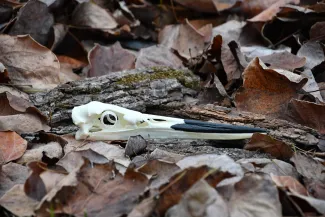
Great Blue Heron Skull
Image
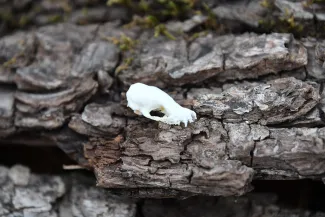
Little Brown Bat Skull
Bird Foraging Activity
The sun is just beginning to rise over the wetland, and it’s time for the birds to begin their day with a nutritious meal! Students will act as birds, attempting to collect as many food items as possible in their cup using tweezers.
Document
Supplies
- (2) 4X4 posts with pipe cleaners
- Animal replicas: worms, snails, fish, frogs, and dragonflies
- (10) Tweezers
- Plastic cups
Activity Setup
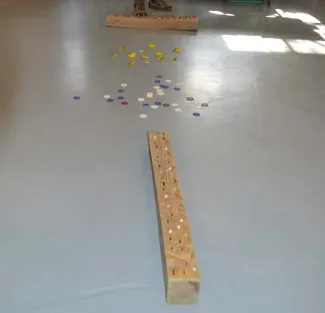
- Fill the 4” x 4” posts with pipe cleaners. The pipe cleaners mimic the aquatic invertebrates the birds will be foraging for, and the post mimics the wetland’s mud.
- Arrange the 4” x 4” posts in the center of the room or activity area.
- Distribute the animal props in a line between the two posts. The animals can be mixed together or separated into distinct groups.
- Once the wetland buffet has been prepared, arrange the birds in equal groups on each side of the wetland.
- Distribute cups and tweezers to the birds.
Image
Play
On your signal, the birds will begin foraging for the different food items using their tweezers. At the end of the activity, have the birds examine their cups and discuss the challenge of foraging for the different food types. Return the food items to the wetland and play again.
Play Alternates
- Birds can forage until no food items are left, or only be allowed to forage for a set time.
- Birds can be divided into “shorebirds” and “wading birds,” with shorebirds only foraging on the invertebrates found in the mud and wading birds only foraging on the larger animals. Shorebirds should forage close to the mud, wading birds should only bend at the waist while foraging.
- Add a foraging challenge by draping the net provided for the tabletop display over the food items. This could mimic vegetation or debris used by the prey for protective cover.
- Points can be assigned to the different food groups (1 point for each pipe cleaner, 2 points for each animal, etc.). If the birds don’t reach the minimum point count for survival, they must leave the wetland. Food items can be removed from the wetland to represent scarcity until one bird remains.