It’s the time of year when Oklahoma’s black bears are waking up and wandering the woods.
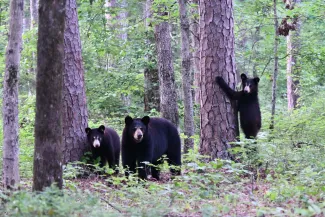
Eastern Oklahoma is home to two growing populations of black bears that have been expanding and dispersing westward out of Arkansas for more than 20 years. Black Bears once inhabited all of what is now the state of Oklahoma. However, by the early 1900s bear sightings had become rare. Habitat fragmentation in combination with overharvest had put Oklahoma’s black bear population in danger of extirpation.
In the late 1950s and early 1960s, about 250 black bears from northern Minnesota and Manitoba, Canada, were translocated to the Ouachita and Ozark Mountains of western Arkansas by the Arkansas Game and Fish Commission. The newly introduced population took root and expanded into southwestern Missouri and eastern Oklahoma. That project is still viewed as one of the most successful reintroductions of large carnivores in the world.
The larger population is well-established in and around the Ouachita Mountain range in southeastern Oklahoma, and a much smaller population resides in some of the favorable habitat found in the Ozark Mountain range in northeastern Oklahoma.
According to research, the black bear population in southeastern Oklahoma, referred to as the Ouachita population, is still growing. The most recent abundance estimate reported by researchers in 2023 was about 1,550 bears, with a much higher concentration along the Oklahoma-Arkansas border. The core area of the Ouachita population lies primarily in southern Le Flore County and reaches slightly down into northern McCurtain County.
Black bears may turn up anywhere east of Interstate 35, as animals from the core eastern areas continue to venture westward. In recent years, black bears have been seen in Ada and Wewoka, as far north as Grove and as far west as Wayne. Black bears are also occasionally seen in the western end of Oklahoma’s Panhandle.
Hunting the Black Bear
The tremendous success of Arkansas’ translocation program led to a renewed black bear hunting season there in 1980. In 2009, Oklahoma’s bear population allowed the Oklahoma Department of Wildlife Conservation to open the state’s first bear hunting season, with a total harvest quota of 20 bears for Latimer, Le Flore, McCurtain and Pushmataha counties. That year, 19 bears were harvested.
In 2010 and 2011, the 20-bear quota was still in place yet 32 and 31 bears were harvested, respectively, within 48 hours of opening day those seasons. In 2012 the 20-bear quote was removed for the archery season, and hunters took 66 bears. In 2013, a year of high mast yields when hunting proved more challenging, the harvest dropped to 28.
In 2019, the hunting zone for black bears was expanded to include the area south of Interstate 40 and east of U.S. 69.
In 2022, the Choctaw Nation began issuing bear licenses to tribal members and added eight bears to the harvest total of 60 for 2022. Black bear hunters in Oklahoma had a record-breaking hunting season in 2023, taking 86 bears, the highest harvest since the previous record of 85 bears set in 2018.
In 2024, all lifetime hunting license holders became exempt from needing to buy a separate bear license. Despite the heavy mast crops in some core areas, hunters took 77 bears that year.
Overall, with increasing popularity of bear hunting and additional participation opportunities, the harvest trend is steadily climbing.
The state’s next black bear archery season will run from Oct. 1-18, 2026, and the bear muzzleloader season will run from Oct. 24 to Nov. 1, 2026.
Human/Bear Conflict
While naturally shy of people and urban areas, black bears will sometimes travel many miles when searching for food, mates or new territory, and they can wind up in some unexpected places. Most bear sightings are in some way food-related and occur in spring and summer months.

- Bears are omnivores and will eat almost anything with calories, but their diet consists of mostly plants. After spending about three months in a den without eating, bears are emerging and leaving their dens in April with a lot of winter weight loss to regain.
- Later in May and June, adult males are traveling for miles to breed, juveniles are dispersing from their mothers, and nursing sows are working hard for extra calories to produce milk for cubs.
- In July and August, as vegetation begins to wither from the seasonal heat and regular rainfall becomes scarce, bears become easily receptive to food sources that originate with people.
Bears have an amazing sense of smell and can easily detect natural food sources as well as unnatural food opportunities such as trash containers, corn feeders, bird feeders or pet food left on a porch. When bears are lured in by these temptations, it can at first seem like a positive encounter. The bear receives a charitable handout, and the property owner gets a cool story and photo opportunity.
However, bears can easily become habituated to these types of easy food sources and can lose their natural weariness of people as they begin to associate the sights, smells and sounds of people with free snacks. When this happens, there is potential for human bear conflicts.
Biologists have learned that relocating a habituated bear does not erase the bear’s memory of the free food, nor does the bear typically adopt the new location. In most cases, even after being moved many miles away, they will return to their home territory within a few days.
The most effective way to manage human/bear conflict is through prevention. Secure anything that might attract a hungry bear out of the woods and into the yard. Simple practices like not leaving excess pet food or full trash containers sitting out overnight, keeping your outdoor grill clean, and shutting down bird feeders during summer are great ways to keep bears from developing harmful habits and avoiding a detrimental experience for bears and property owners.
The Oklahoma Department of Wildlife Conservation is a member of an education and outreach organization called BearWise that is dedicated to helping people live safely and responsibly with bears. For advice about making your property a safer place and coexisting with bears, go online to bearwise.org or facebook.com/BearWise.org.
This article first appeared in the March/April 2026 issue of Outdoor Oklahoma.