I grew up in northern Illinois. As such, my sense of seasons was tied to the weather and the trees. There were four distinct seasons I knew as a youth:
- Summer: hot, humid weather, lush green trees standing in the black loamy soil, and plentiful summer storms.
- Fall: a crisp breeze in the air with beautiful red and yellow leaves everywhere, falling to the ground.
- Winter: frigid temperatures and bare tree branches beautifully covered in fresh powdery snow.
- Spring: thawing temperatures and flowering trees.
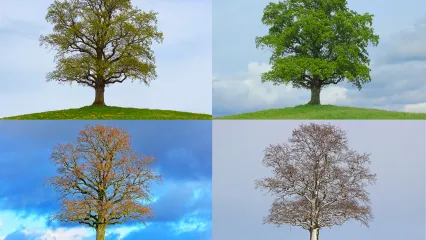
When I moved to Texas and then Oklahoma, the passage of seasons was less stark. The leaves turned brown and sometimes stayed on the trees all winter. The crisp, cool breeze would falter and reverse itself into a sweltering heat.
My mind has been left wanting for another clear frame of reference for the passage of time.
In ecology, the study of the passing of seasons is referred to as phenology. The National Park Service explains phenology as “the study of recurring plant and animal life cycle events, or phenophases, such as leafing and flowering, maturation of plants, emergence of insects, and migration of birds.”
After moving to Oklahoma, I have also become interested in birding. As such, my perception of the passage of seasons can now be tied to the migration of birds through or to my backyard in Oklahoma City, along with the changes to the native plants I have placed in my yard to establish beneficial habitat for these species.
Phenology is an easy activity to help you become more attuned to the natural areas around you, including (maybe most importantly) your backyard! It’s as easy as marking dates on a calendar (either a virtual calendar on your mobile phone or a paper calendar).
Mark the first day you notice a specific species of bird in your yard, or the first day you notice a sprout coming out of the dirt on a native plant, or the first time you notice an insect – even if it’s a mosquito! Then, the next year, you can look ahead and know what to expect and create comparisons across years.
And if you are feeling curious and want to investigate, you could try to determine why some phenological event might have happened earlier or later than it did the previous year.
Winter
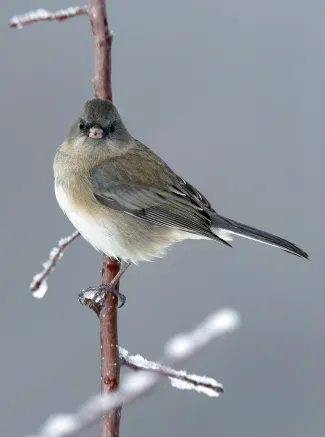
In late fall and early winter, I begin putting out bird feeders because natural food sources become scarcer for our backyard birds. I fill the feeders, and my partner always says, “Make sure to put some feed on the ground for the dove and dark-eyed juncos once they get here!"
He eagerly awaits the day that we see a dark-eyed junco on the ground as the northern cardinals take turns visiting the squirrel-proof feeders. The junco means that winter has arrived.
According to the Audubon website, this phenomenon we have observed tracks with their migration. They arrive at their winter range, which includes Oklahoma, in early to late November and stick around until early to late March.
Another winter visitor to our yard is a species that was a complete surprise to me. I remember one summer I was in the high mountains of Colorado and got so excited when I saw a white-crowned sparrow. It was a beautiful bird with alternating black and white stripes down its head and neck, jumping around at 12,500 feet in elevation. I told my partner, and he said, “Oh yeah, we get those in the yard in the winter!” Lo and behold, the next winter I saw a white-crowned sparrow and was astounded.
Their summer range is typically in Canada but they also summer in a small area of the high mountains of Colorado. Then they start arriving in Oklahoma in November and December.
Spring
Spring is always an exciting time. Oklahoma gets a lot of exciting birds migrating through in large numbers, however many of the species that arrive after the cold winter don’t stick around for long. Spring migration tends to be much more concentrated than fall migration.
When I was living in Illinois, my favorite arrival in spring was the cedar waxwing. To my surprise, these sleek-looking birds winter in Oklahoma and often can be seen here through late spring. They travel in groups, and we typically see at least 10 sitting together on high branches of the trees in our yard. I always try to snap a picture before they leave, especially when the sun is glinting off their yellow-tinged feathers.
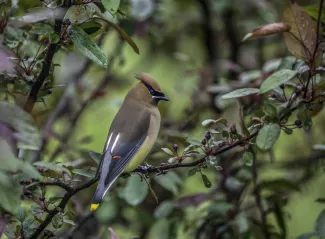
Though cedar waxwings are preparing for their migration out of Oklahoma, dozens of other species are migrating into the state during the spring season. Our state bird, the scissor-tailed flycatcher, can be seen across much of the state spring through fall, as can barn swallows, Eastern phoebes, and a suite of other migrating birds.
Summer
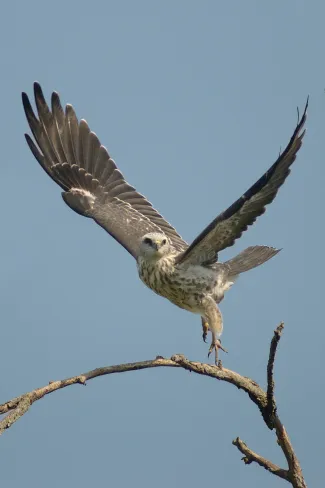
I was inspired to write this article because I saw a Mississippi kite soaring near my home on April 29. Each spring, we anxiously await our neighborhood kites that nest and sit atop power poles, surveying the neighborhood for insects to eat.
As soon as the Mississippi kites arrive, we know that summer and the accompanying summer heat is about to arrive. This tracks with their migration, as they spend the winter in central South America, inhabiting parts of Bolivia, Paraguay, Uruguay, Argentina and Brazil.
The Audubon website shows that their spring migration happens from March through May. These birds travel that far just to hang out on the power poles in our neighborhoods, and we are so excited when they arrive.
The kites begin their journey south again in mid- to late August.
Fall
As I was considering which species makes me feel like fall is on the way, I was having a hard time and then realized that maybe it is the absence of so many species that feels most like fall.
The plants around me are senescing (fading), birds are migrating after their breeding season but not in large numbers at once. In the fall, migration is much more spread out based on the success of nesting pairs. As such, fall migration is not as showy as spring. For this reason, I can appreciate the other seasons and the excitement they bring even more, and settle in for the coming long nights of winter and the anticipation of those the dark-eyed juncos.