Chronic Wasting Disease (CWD)
What is Chronic Wasting Disease?
Chronic Wasting Disease (CWD) is a neurological disease that affects the brains of deer, elk, moose, and other members of the deer family. Misfolded proteins called prions create microscopic holes in the brain that resemble a sponge when viewed under a microscope.
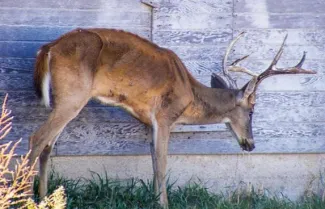
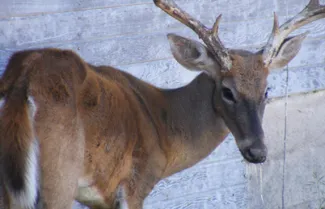
The disease leads to severe weight loss, lack of coordination, drooling and behavioral changes like loss of fear.
Image
Mike Hopper/KDWPT
Image
Mike Hopper/KDWPT
How is CWD spread?
The disease spreads through direct contact with infected individuals or an environment contaminated with infectious material. Infectious prions have been detected in urine, feces, saliva , and many tissues of infected animals such as muscle. Long after an infected carcass decomposes, the soil may remain infectious for years, possibly exposing other deer to the prions that cause CWD. To avoid this exposure risk, proper disposal methods are recommended.
Can CWD be spread to humans?
CWD transmission to humans or livestock has not been documented. However, the U.S. Centers for Disease Control and Prevention recommends, as a precaution, that people or animals do not eat any part of an animal diagnosed with or showing signs of CWD.
What are the symptoms of CWD?
Infected animals gradually lose body condition, becoming emaciated or "wasted". They may display a wide stance, staggering gait, or inability to keep their head up and have excessive salivation and thirst. However, CWD positive animals may not show symptoms for years.
CWD is always fatal to the animal. There is no vaccine or treatment against the disease.
How is CWD diagnosed?
Approved tests in free-ranging cervids involve directly testing lymph node and brainstem. For this reason, states with CWD positive animals in wild herds use hunter-harvested animals as the most reliable method for obtaining sufficient numbers for surveillance.
What is Oklahoma doing?
CWD has been confirmed in wild deer and/or elk in Oklahoma and surrounding states including Texas, New Mexico, Colorado, Kansas, Missouri, and Arkansas. To minimize the potential spread of CWD, the Oklahoma Department of Wildlife Conservation is recommending certain deer carcass handling practices to minimize the potential spread of CWD.
Go to Selective Surveillance Areas (SSA)
Proper Disposal
Burial on site:
Whenever possible, deer or elk carcasses should be buried on the property where it was harvested. Burial should be deep enough to prevent exposure to the surrounding environment by scavengers.
Approved, lined landfills:
Infectious prions are highly unlikely to migrate out of an approved sanitary landfill and infect other deer or elk. Deer and elk remains can be disposed of in household garbage that is hauled to a landfill via regular trash collection.
Leave in place:
If burial is not possible where the deer or elk was harvested, the remains may be left on site. If CWD is already present on the property, it is unlikely to be spread by scavengers to another property where the disease is not found.
Improper Disposal
Disposal in water:
Do not dispose of carcasses in ponds, lakes or waterways. This has the potential to spread infectious prions to areas previously uninfected.
Burning:
Only closed commercial incinerators are capable of generating enough heat to destroy the prions as well as being the only lawful type of incineration. Leaving the carcass in place is equally effective while not presenting a fire danger or air quality issue.
Transport to another property:
Remains of harvested deer or elk that are transported to a different property for processing should not be dumped on the landscape where it could infect the environment. Instead, the remains should be sent to a landfill . Burial on a different property is acceptable if the remains are buried deep enough so as not to become exposed to the surrounding environment by scavengers, thus making the prion accessible to deer and elk in the area.
CWD in Oklahoma
ODWC’s primary objective is to minimize the CWD risk to Oklahoma's wild deer, elk, and other susceptible cervids within our borders.

Oklahoma’s CWD timeline:
1998: CWD was confirmed in a captive elk herd in Oklahoma County. The elk had originally been imported from Montana. The U.S. Department of Agriculture euthanized the herd to decrease the threat of the disease spreading into the surrounding free-ranging deer herd.
2019: CWD was confirmed in one farmed elk in Lincoln County. ODWC increased disease surveillance and monitoring in areas adjacent to the breeding facility.
2022: A road-killed deer infected with CWD was found 2.5 miles south of the Oklahoma-Texas border near Felt in southwestern Cimarron County. With the proximity of this infected deer to Oklahoma's border, ODWC activated its CWD Response Strategy. This includes the designation of Selective Surveillance Areas (SSA).
Go to Selective Surveillance Areas (SSA)
June 6, 2023: In Texas County CWD was confirmed for the first time in a free-ranging wild deer. This case marks the first time the disease has been detected in laboratory testing of tissue samples from more than 10,000 wild deer and elk throughout Oklahoma. This is the first case of CWD in a wild deer in Oklahoma.
2023: A wild deer was confirmed to be infected with CWD. The deer was located about 15 miles east of Woodward in Woodward County.
2024: A deer near Felt tested positive for CWD. The existing Cimarron County SSA was expanded.
2025: CWD was confirmed in a wild deer in the Oklahoma Panhandle.
2025: A hunter harvested a deer infected with CWD less than four miles east of the Oklahoma-Arkansas border near McCurtain County. With the proximity of this infected deer to Oklahoma's border, ODWC activated its CWD Response Strategy.
February 6, 2026: A CWD-positive deer was harvested about 3.5 miles west of Felt, near the location where a CWD-positive deer was confirmed in 2025. Since this latest infected animal was taken so close to the previous one, the current SSA in Cimarron County will remain unchanged; no new area will be added.
September 28, 2026: A white-tailed deer located about two miles south of Optima in Texas County tested positive for CWD. The existing SSA in Texas County was expanded.
ODWC actively reviews and updates its response strategy to align with emerging scientific research. ODWC also coordinates with the Oklahoma Department of Agriculture, Food and Forestry, and other agencies to monitor the state’s captive cervid herds and provide information to the public as it becomes available.
Importation of Cervid Carcasses or Carcass Parts
No person shall import, transport, or possess any cervid carcass or part of a cervid carcass from outside the boundaries of Oklahoma. The following items are the only exceptions:
- Antlers or antlers attached to clean skull plate or cleaned skulls (all tissue removed);
- Animal quarters containing no spinal materials, or meat with all parts of the spinal column removed;
- Cleaned teeth;
- Finished taxidermy products;
- Hides or tanned products;
- Harvested deer, elk or other cervidae if they are going to a taxidermist in good standing with the Secretary of State