A University of Oklahoma student blended an early foundation in science with her talent for art to create a digital field guide of Oklahoma’s endangered species. Check out her work and learn how a science illustration assignment gave her a better appreciation for Oklahoma’s fish and wildlife.
It’s safe to say Rosalie Dobbs’ passion for science comes naturally. Between watching her mom pursue an advanced degree in biology and later a career as an advisor in a university’s biology department, Dobbs fondly remembers her early homelife as “always very science-y.” When it came time for her own academic journey at the University of Oklahoma, fields of study like public health, medical science, and plant biology were at the top of her list of potential majors. But after the diagnosis of a learning disorder and then a physical disability, she ultimately followed another passion: art, with a side of science.
“There’s all these things in art that are based in neurology — just things your brain likes that are baked into art,” Dobbs explained.
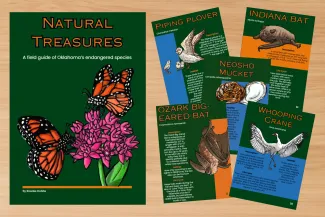
Throughout her coursework, Dobbs has been learning to use those captivating tricks of the trade, including fundamentals like the “rule of three” and the best use of contrasting line weights and colors. Nature and landscapes have been go-to subjects for Dobbs, and she was able to further blend her foundation in science with her skills as an artist in a midterm assignment for an independent study course on science illustration. She paired hand-drawn and digitally painted illustrations of 13 animals with biological information to create a digital field guide of Oklahoma’s endangered species.
Image
Jena Donnell/ODWC
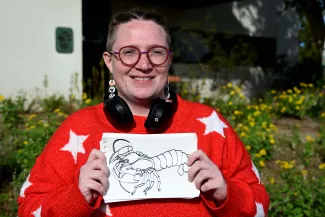
Rosalie Dobbs, a multidisciplinary studies student at the University of Oklahoma, holds line art from her recently completed field guide of Oklahoma’s endangered species.
The idea of a field guide, an example provided in the class assignment, was especially intriguing to Dobbs.
“I’m not from Oklahoma, so I’m not as familiar with the (state’s) animals. I thought it would be fun to look at what we’re trying to protect in Oklahoma.”
After seeing the list of more than 20 state- and federally listed species at wildlifedepartment.com, she decided to focus only on 12 species listed as “endangered” and used the monarch, a candidate for federal listing, for the cover.
Each initial sketch took about 30 minutes to complete — the state endangered Oklahoma cave crayfish, with all its body and leg segments and mouthparts, took considerably longer. The digital paintings, completed using a stylus and a drawing tablet, took about two hours for each species.
Behind the Scenes: The Making of a Science Illustration
Dobbs created digital paintings of endangered species found in Oklahoma for a midterm science illustration project. Click to watch as she turns her line drawings of an Oklahoma cave crayfish, scaleshell, and longnose darter into colorful works of art.
Dobbs leaned on her love of learning for the project’s first step: research. In addition to learning more about the species featured in her project, she needed a better idea of what each animal looked like. She searched for reference photos showing varying poses and anatomical details and used them to create her own outlines, or line art, in a process she described as “Frankensteining.”
“For the piping plover, I found a photo of a bird sitting down with its feet in a certain way and another of one flying and sort of combined those poses. For other species, I found very few images; fortunately, there’s not a lot of ways to pose a mussel. But the fewer references you have, the less certain you can be of your own work.”
Dobbs sketched an outline of each animal on paper using pens with angled tips to create different line weights and give a sense of visual contrast. She then scanned and uploaded the line art into a software program that came with her drawing tablet. The program’s various settings allowed Dobbs to change the brush types mimicked on the screen and create layers of strokes, color, and fine details with the tablet’s stylus. With each progressive layer she could alter, delete, and reapply certain strokes or colors without changing the layer beneath.
“With any kind of art, you’re sort of fighting with your tools to be able to get it to look the way it looks in your head,” Dobbs said. “The hardest part (of digital painting) for me was not looking at my hands. It was really difficult to train myself to look at the screen.
“In art and in life, you have to understand that for any new skill, you’re going to be bad at it in the beginning. You just have to be like, ‘This is going to be ugly. But I’m going to do it anyway.’ You just have to put in the time and the work and the effort.”
With each piece, Dobbs came to appreciate something she hadn’t noticed before. “I’ve never noticed that bat wings have a texture. I always thought it was just smooth, like skin.”
That observation came as she was preparing to sketch the Indiana bat and found a reference photo where the bat’s wings were partially folded. “With the wing folded, the skin had bunched up in a way that gave it this sort of bumpy look.”
Image
Rosalie Dobbs
Rosalie Dobbs created artwork for 13 Oklahoma species for a science illustration course. Each piece brought her a better appreciation for the animals, and she hopes to inspire others to look at wildlife in a new way.
The four endangered mussels provided another surprise. “I really liked the way some of the mussels turned out. I have never made a color painting of a mussel before. Actually, they were fun color studies.
“I think the challenging thing for the mussels wasn’t necessarily the art; it was the research. Biologically, they’re not super varied. I didn’t want to have the information sections be the same, so I chose to focus on different aspects of their biology for each species.”
When Dobbs showed her finished project to classmates, she got a third surprise. “The Oklahoma cave crayfish was the favorite.
“It was the hardest to draw, but I feel like it’s boring, really. There was very little work required to do the colors. It’s all very monochrome; I did a flat blue, some highlights, and some blending. Most of the work was the line work, and the coloring was very simple. It perplexes me that it’s everyone’s favorite.”
As for her favorite, Dobbs pointed to the Ozark big-eared bat. “The pose was fun, and I like its big, cute ears.”
Another species, the whooping crane, brought a more emotional connection. “One of the things in New Mexico that I have done with my mother is visit Bosque del Apache National Wildlife Refuge. Drawing the whooping crane reminded me of going on road trips with my mom and seeing sandhill cranes.
“I feel like when you ask people what their favorite animal is, you find a lot of time it’s not specifically the animal, it’s their experiences in their life that the animal reminds them of. This drawing reminds me of my mother.”
Dobbs hopes science illustration and work like her midterm project can help people build similar connections to wildlife and endangered species.
“Conservation is really important, but people can get bogged down in all of the negative. When I was doing this project, I wanted it to be more of an appreciation for the animals and what they’re like, to approach people from an angle of curiosity and passion and appreciation for the beauty of wildlife.”
The project has also reinforced Dobbs’ interest in blending science and art for a future career.
“With my physical disability and learning disorder, my path has been going back and forth. I want to do public health and don’t think I could do a nine-to-five at, like, the CDC. But I might be able to write about science. So, I’m now officially a multidisciplinary studies major with an emphasis in writing and art, because those are my talents and things I can physically do. Gig work like writing and art are just more flexible. But I still want to do science.
“I think it’s important to be able to have someone who can understand science but can also communicate with the public.”
Want more science illustration? The Wildlife Department’s Kurt Kuklinski brushed off his own college notebook and shared how sketching fish helped build field identification skills that influenced his career.