Rolling down Route 66 this summer? Between photo ops, diner food, and getting your proverbial kicks, keep an eye out for a roadside attraction that can be seen along every mile of the historic highway — wildlife! Because the famous road crosses the state from east to west, motorists can get a windshield-level look as Oklahoma shifts from forest to prairie and the wildlife communities gradually change with the habitat.
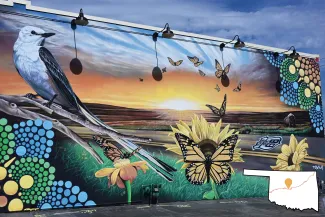
No matter which section of the route you’re traveling, or on which of the dozens of road alignments you find yourself, there’s likely a bird, butterfly, frog, squirrel, or fish nearby. The trick is to train or adjust your search image. In addition to looking for colorful landmarks and time-honored attractions along Route 66, don’t forget to scan for birds perched on roadside fences, lizards skittering at the parking lot’s edge, or fish swimming just below the stream surface. Movement oftentimes catches the eye of the experienced wildlife-watcher; spending just a few minutes watching or listening for movement can increase your odds of spotting one or dozens of Oklahoma’s incredible species and make your road trip a little more wild.
Put an Oklahoma spin on the classic road trip game of counting cows by tallying scissor-tailed flycatchers and red-tailed hawks, Oklahoma’s state bird and state raptor, spotted along Route 66!
Putting Your Route 66 Sightings on the Map
Your wildlife sightings along The Mother Road can live long after the road trip if you document the what, when, and where in your phone’s camera roll, in the glovebox notebook, or on a free nature app like iNaturalist or eBird. That last option comes with three amazing perks: identification recommendations; a sneak peek at what could be spotted at your next stop; and your road trip contributing to science!
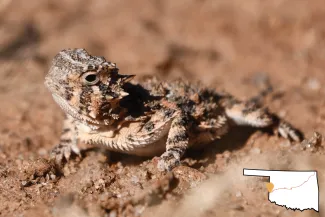
Perk 1: When you upload a photograph with your iNaturalist observations, the app automatically generates suggestions — sometimes to species, sometimes to a group of related species — and lets you easily edit your post as you learn more or if other iNaturalists chime in with recommendations. Merlin Bird ID, a companion to the eBird app, uses your device’s microphone to record the birds calling around you and makes recommendations based on the resulting spectrograms. If you agree with Merlin’s results, your bird list can then be added to eBird.
Perk 2: Nature apps not only archive your sightings (you can obscure your location for privacy) but also show what other people have logged at upcoming attractions. This can help you further adjust your search image for a target bird, bee, or blossom.
- At the Blue Whale of Catoosa, birders have logged 32 species flitting, singing, and swimming near the 80-foot landmark.
- More than 200 birds and hundreds of plants, insects, turtles, and spiders have been reported on either side of Route 66 at Oklahoma City’s Stinchcomb Wildlife Refuge and Lake Overholser.
- At least 100 bird species have been spotted at Acme Brick Park Pond near Clinton’s Route 66 Museum.
It may not show up on eBird, but loads of motorists have spotted a special cuckoo bird perched atop Waylon’s Ku-Ku Burger sign. (If you venture through Miami, be sure to add the sighting to your Route 66 bird list … then celebrate your creative birding skills with an ice cream!)
Perk 3: Sharing your sightings is one of the easiest ways to contribute to science and conservation! It’s something you can do whether you’re new to nature or have years of experience, and every sighting helps biologists learn a little more about our state’s natural resources.
More: What to Share and How to Share It
More Wild Sightings Within the Route 66 Corridor
When Route 66 opened in 1926, it wasn’t a single new highway but a mix of existing paved and dirt roadways. (U.S. 66 wouldn’t be completely paved in Oklahoma until 1937.) To celebrate those early dirt roads and the many alignments that came after the original route, we encourage you to venture off the beaten path and explore nature within the Route 66 corridor. Wandering a few miles from the historic route may add a little bit of time to your travel plans but also may add new Oklahoma experiences and new species to your list.
The Wildlife Department manages seven areas that touch or where some acres are within 10 miles of Route 66…and another nine that are within a 20-mile corridor. Get Wildlife Management Area details and find out which require a valid hunting or fishing license or Conservation Passport at wildlifedepartment.com.
- ODWC Areas within 10 miles of Route 66: Neosho WMA, Oologah WMA, Heyburn WMA, Deep Fork WMA, Arcadia Conservation Education Area, American Horse Lake, and Sandy Sanders WMA
- ODWC Areas within 20 miles of Route 66: Spavinaw GMA and PHA, Fort Gibson PHA, Skiatook WMA, Keystone WMA, Okmulgee GMA and PHA, Fort Cobb WMA, Washita County WMA, Altus-Lugert WMA, and Black Kettle WMA
Even the Mascots are Wild on Route 66
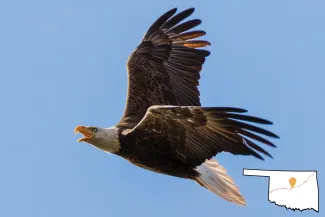
Cruising Main Street of America comes with the chance for another kind of wild encounter — mascots! At least 16 towns from Quapaw to Erick have taken on a version of Oklahoma’s wildlife as a school symbol. In addition to wildcats and bearcats (it's a bit of a stretch, but we're here for it!), public schools along Route 66 are represented by bobcats, panthers, hornets, elk, bison, redhawks (is anyone else getting strong red-tailed hawk vibes?), and cardinals. Four schools, Afton, Big Cabin, Weatherford and Sayre, are flying their school spirit with an eagle mascot, the most popular of Oklahoma's native animal mascots! The birds-as-mascots theme continues for three of Oklahoma’s higher education institutions located near the historic route: Oral Roberts University has the golden eagle as a mascot and Tulsa Community College and Oklahoma City Community College surprisingly — or unsurprisingly if you’ve ever come across a “spirited” nesting pair — have the Canada goose!
No matter how you travel the famous highway, and no matter when, you’ll undoubtedly find selfie-worthy landmarks, fun attractions, and nuggets of Oklahoma history along The Mother Road. But you can also discover where wild things are “if you ever plan to motor west” and “get your kicks on Route 66.”