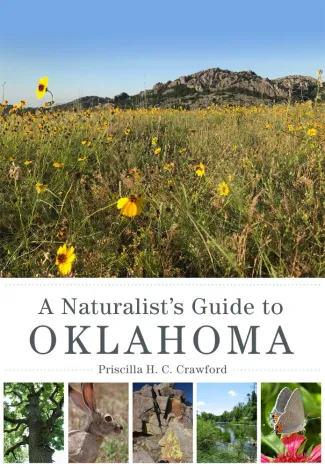
"A Naturalist’s Guide to Oklahoma" can be your trail guide for learning about common and rare plants and animals, recognizing habitats, and understanding natural histories. Reading this book is like taking a friendly hike with the author and getting a personal tour of Oklahoma.
Becoming a naturalist — learning about plants and animals, recognizing habitats, and understanding natural strategies and relationships — can be a lifelong adventure. That fun (and sometimes frustrating) journey is often made easier when a patient trail guide points out clues for identification and offers tips, tricks, and helpful reminders along the way. Priscilla Crawford’s new book "A Naturalist’s Guide to Oklahoma" can be that trail guide. Reading this book is like taking a friendly hike with the author and getting a personal tour of Oklahoma’s natural world.
“This book is an invitation for people to celebrate Oklahoma,” Crawford said. “For the size of the state, Oklahoma has a high degree of diversity. We can see the alligator swamplands in the Southeast and the bighorn sheep mesa lands in the Panhandle. It’s interesting to have that much diversity in a state.
“Oklahoma’s diversity surprises a lot of people. Even people that have lived here their whole life may find an opportunity to appreciate Oklahoma in a new way.”
Crawford has studied and worked in Oklahoma for more than 25 years, adding an extra layer of authenticity to the book with first-hand experiences and memories from the field sprinkled throughout the pages. Though she’s traveled the state as an ecologist studying mesquite grasslands, surveying endangered birds, and looking for invasive aquatic plants, she still picked up a few new nature nuggets while writing "A Naturalist’s Guide to Oklahoma" and rediscovered a piece of home in her adopted state.
“While writing, I felt like ‘I know the Cross Timbers,’” Crawford said. “But then I asked other experts and naturalists for input and learned so much more.” Among her new discoveries were that narrow-mouthed toads can form an ecological partnership with the brown tarantula, and that a female firefly found in Oklahoma can lure males of a different species so that she can capture and eat them, sequestering the other species’ defensive chemicals for herself.
“I don’t know how long you’d have to live and work in the state to learn all of these fascinating stories.”
For writing inspiration, Crawford ventured to various ecoregions and even stayed in a cabin to draft the chapter about the Ozark Plateau.
“I wrote much of that chapter while looking out over a hollow,” Crawford said. “I really enjoyed spending time in the Ozark Plateau. It reminds me of southern Indiana — the limestone topography and tall trees. I got to learn the flora and fauna of where I grew up, only here in Oklahoma.”
Crawford hopes "A Naturalist’s Guide to Oklahoma" will inspire others to make similar nature discovery trips. After describing the ecoregion’s features and distinctive plants and animals, she includes a list of places to visit and explore different habitats for each chapter.
“The hope is that people learn to appreciate how interesting Oklahoma is. There are so many cool things to see and learn that even outdoorsy people may not know.”
Crawford is an ecologist and conservation specialist at the Oklahoma Biological Survey, a state agency and research department of the University of Oklahoma. “Our mission is to provide biodiversity information in the state. I hope this book is a good tool to showcase the state.” Royalties from "A Naturalist’s Guide to Oklahoma" will go to the Oklahoma Biological Survey to support conservation programs.
Hooked on reading? Whether you’re looking for a tale of adventure, a guide to birds and fishing, inspiration for cooking wild game, or a story that celebrates the outdoors, ODWC has you covered! Check out our wild summer reading list of more than 20 outdoor-inspired titles.