To celebrate the 250th anniversary of the United States, we’ve dug deep into field guides and reference books to find Oklahoma fish and wildlife that have a tie to our country’s history and heritage. From the red, white, and blue to those “officially” named in 1776, we’ve got dozens of wild America examples and trivia that are basically firecrackers for your brain.
The Red, White, and Blue
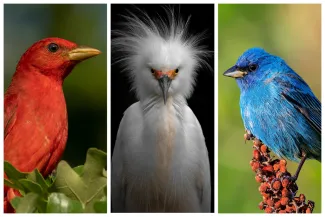
The United States has long been represented by the red, white, and blue — even before the first Stars and Stripes flag in 1777. And these patriotic colors can be found in Oklahoma’s natural communities. In addition to summer tanagers, snowy egrets, and indigo buntings, Oklahoma has cardinal shiners, whooping cranes, and blue suckers; red foxes, checkered whites, and blue jays; along with many other red, white, and blue species!
Oklahoma’s fish and wildlife also may embody the symbolism behind the red, white, and blue. When the Great Seal of the United States was adopted in 1782, red was said to signify hardiness and valor, white purity and innocence, and blue vigilance, perseverance, and justice. The hardy Red River pupfish can endure high water temperatures, salinity, and alkalinity in the braided rivers and streams of southwestern Oklahoma. The mourning dove is a time-honored example of innocence and purity. And the scissor-tailed flycatcher — Oklahoma’s state bird — is alert to passing insects and quick to defend its territory.
Red, White, and Blue Wild Trivia
- The male summer tanager is the only all red bird found in Oklahoma. (Northern cardinals have a black face mask.)
- The bald eagle — our Nation’s bird — does not molt into the tell-tale white head and tail until about 4.5 years of age.
- Most blue feathers aren’t the result of a pigment. Instead, the blue color is produced when light is refracted by proteins in the feather and the remaining colors are absorbed by the melanin layer at the center of the feather barb.
Since 1776
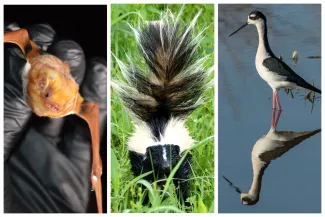
While the Founding Fathers were drafting and signing the Declaration of Independence in 1776, two German naturalists were publishing their own works. Instead of creating a new government, Johann Christian Daniel von Schreber was describing the striped skunk, and Philipp Ludwig Statius Müller was documenting the eastern red bat, black-necked stilt, rusty blackbird, and tricolored heron. Though 1776 was the first time these five Oklahoma species had been described for science, they had been previously named, observed, and collected in the Americas.
Wild Trivia
- The eastern red bat is thought to occur in each of Oklahoma’s 77 counties.
- After mating, the black-necked stilt pair crosses bills and runs together for a few steps. Sometimes the male drapes a wing over the females back during this ritual.
- The scientific name for the striped skunk, Mephitis mephitis, means “noxious vapor” or "stink stink" in Latin.
All-American
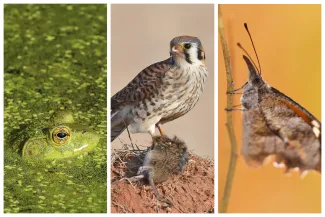
From the American toad to the American robin, there’s no shortage of All-American species. Oftentimes, early naturalists and explorers used “American” monikers to help distinguish New World species from Old World. (It was also trendy to include regional names back in the day…) At least 55 species of fish and wildlife found in Oklahoma carry “American” in their common or scientific names. Another 70-ish Oklahoma plants carry the name.
- Oklahoma’s All-American Species
Birds (24): American avocet, American barn owl, American bittern, American black duck, American coot, American crow, American golden-plover, American goldfinch, American herring gull, American kestrel, American pipit, American robin, American redstart, American tree sparrow, American white pelican, American widgeon, and American woodcock. Seven other species tip their hat to the country in their scientific name: brown creeper, dickcissel, long-billed curlew, northern parula, redhead, whooping crane, and yellow-billed cuckoo.
Amphibians (2): American bullfrog, and American toad.
Reptiles (2): American alligator and North American racer.
Mammals (12): American badger, American beaver, American bison, American black bear, American elk, American hog-nosed skunk, American mink, American parastrelle, American perimyotis, North American deermouse and North American porcupine. The pronghorn’s scientific name is Antilocapra americana.
Fish (4): American eel, American gizzard shad, and American paddlefish. The redfin pickerel’s scientific name is Esox americanus.
Invertebrates (11): American bird’s wing moth; American bumble bee, American burying beetle, American carpenter ant, American carrion beetle, American copper, American dagger moth, American lady, American pistol casebearer moth, American plum borer moth, and American snout.
Plants (72): Alkali American-aster, American alumroot, American ash, American barnyard grass, American basswood, American beakgrain, American beautyberry, American beech, American bellflower, American bindweed, American bird’s-foot trefoil, American bittersweet, American black elderberry, American black nightshade, American bladdernut, American bluehearts, American brooklime, American buckwheat vine, American bungleweed, American bugseed, American bulrush, American burnweed, North American calceolaria, American columbo, American cupscale, American eelgrass, American elm, American featherfoil, American feverfew, American germander, American ginseng, American groundnut, American hazelnut, American hogpeanut, American holly, American hornbeam, American ipecac, American knotweed, American licorice, American lopseed, American mistletoe, American pennyroyal, American pillwort, American pinesap, American plum, American pokeweed, American prickly ash, American purple vetch, American red raspberry, American rubyspot, American sea-blite, American silverberry, American smoketree, American snowbell, American spongeplant, American star-thistle, American strawberry-bush, American sweetflag, American sycamore, American trout-lily, American water plantain, American watermilfoil, American water-willow, American waterwort, American white waterlily, American wild carrot, American wisteria, American witchhazel, American woodland strawberry, and American yellow lady’s slipper.
All-American Wild Trivia
- The American bullfrog is Oklahoma’s state amphibian. While it has expanded into western states and become an invasive species there, it is native to Oklahoma.
- The American carrion beetle lays its eggs on dead vertebrates and the hatched larvae feed on the corpse. The American burying beetle buries the carrion and lays its eggs in the same burrow.
- North American porcupine young are called porcupettes.
National Symbols
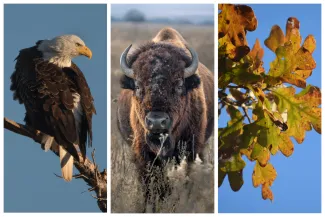
Title 36 of the U.S. Code designates a national floral emblem, a national tree, a national mammal, and a national bird, all of which occur in Oklahoma!
The two plant symbols were designated within the last 40 years, and neither is identified to species in the respective proclamations. The rose was selected as the national floral emblem in 1986. While a type of garden rose or "Noisette rose" was first cultivated in South Carolina and is thought to be one of the first American rose classes, it is a hybrid of Old World rose species. (Ditto for a variety named for George Washington's mother, the Mary Washington rose.) At least seven species in the genus Rosa are thought to be native to Oklahoma, including the Carolina or pasture rose. The genus Quercus, or oak, was recognized by Congress as the national tree in 2004. At least 25 oak species have been documented in the state, including the widespread post, blackjack, and bur oaks as well as the lesser known bluejack, Mohr, and swamp chestnut oaks.
The two animal symbols have an even more recent “official” history. The American bison — North America’s largest native mammal — was designated the national mammal in 2016. Massive bison herds once ranged across the Great Plains but were overhunted and eventually extirpated from the state. Captive herds have since been reestablished, including at the Wichita Mountains Wildlife Refuge and Joseph H. Williams Tallgrass Prairie Preserve. And while the bald eagle has long been considered the national bird — and was adopted in the Great Seal in 1782 — it wasn’t officially named a national symbol until 2024. More than 300 pairs of bald eagles are thought to nest in Oklahoma.
Wild Symbol Trivia
- Rumor has it Benjamin Franklin wanted the wild turkey as a national symbol. And though he once criticized the eagle design in the Great Seal in a letter to his daughter, he never proposed the wild turkey be adopted as the national bird.
- The bald eagle was officially removed from the U.S. Fish and Wildlife Service's List of Endangered and Threatened Wildlife in 2007. Federal protection for the bird continues by way of the Migratory Bird Treaty Act of 1918 and the Bald and Golden Eagle Protection Act of 1940.
- Oaks can be divided into two sections: red oaks and white oaks. Members of the red oak section typically have awns at the ends of leaf lobes and bear acorns on the previous year’s wood. Members of the white oak section lack awns on the leaves and bear acorns on the current year’s wood.