
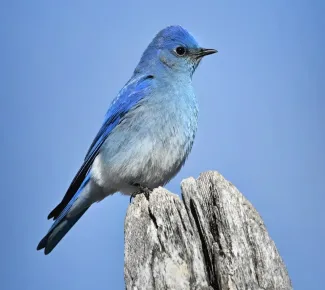
The mountain bluebird (Sialia currucoides) is a small thrush with a round head, thin bill, and brilliant bright blue plumage on the male of the species.
Exhibiting sexual dimorphism, the females have a gray-brown body with hints of sky-blue on their wings and tail. The belly feathers range from a pale rusty brown to grayish color, and a thin white eye ring is present. Juveniles share similar characteristics to the females, but have speckles and streaks on the back and belly.
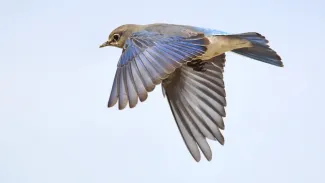
An adult male stands out in the wild with its intense, cerulean blue feathered body that tends to be a darker shade of blue above and a lighter blue-white below. The tips of the wings and tail are dark gray.
These birds are about 6 to 8 inches long, weigh only about an ounce, and have a wingspan of 11 to 14 inches.
Mountain bluebirds occupy western North America. They migrate in fall and spring, and their winter range varies depending on available food supplies. During the nonbreeding season, these birds can be seen in western Oklahoma, preferring vast meadows with scattered trees such as prairie and sagebrush steppe.
They are often spotted in mountainous areas at middle elevations in trees like conifers, but they have been seen as high as 14,000 feet. This species also will hang out around human-altered pastures and will nest in artificial bluebird boxes.
Similar to other bluebirds, mountain bluebirds pounce from perches to catch their food from the ground or in midair. But unlike other bluebirds, they can hover kestrel-like before pouncing on prey. The hovering technique is used mostly when food is scarce. They primarily feed on small invertebrates including crickets and spiders, and also eat fruit seeds and berries during winter.
The breeding range of these birds stretches from Arizona and New Mexico northward into Alaska. During winter, they move south to areas from Nebraska to central Mexico.
Mountain bluebirds are more commonly seen in Oklahoma during the winter months, and they can appear anywhere in the state west of Interstate 35. But it’s possible to spot one in the extreme western end of Oklahoma’s Panhandle at any time of the year.
Mountain bluebirds begin to pair and lay eggs from mid-April to early August. Males of the species venture out to find a suitable nesting cavity such as a knothole or small rock fissure for the female to choose from. They tend to favor dry cavities within 3 feet of the ground.
Once a courting male finds a nest cavity and a female, he will sing and fly back and forth between the two. The female will lay four or five eggs and incubate them about two weeks before they hatch. Both male and female fiercely protect the nest. The young take an additional three weeks to leave the nest.
Post-breeding flocks of 30 or more mountain bluebirds will later form, travel out of sight for days or weeks, return to the nesting areas, then disappear from the territory once the last fledglings become mobile.
The mountain bluebird is the state bird of Idaho and Nevada. It is said that Twitter’s original bird logo was based on the mountain bluebird.