
In 2018, Piedmont resident Thomas Hall rummaged in his pocket for his phone and snapped a picture directly above an ornate box turtle he had found in his backyard. He's since collected images of every turtle he's found on his property. And because each shell has a unique pattern, he's been able to identify individual turtles and has seen a shell go through a repair process over four years.
Growing up on the south side of Oklahoma City, Thomas Hall’s childhood was filled with a fascination for outdoor wildlife. After retiring from managing construction projects, Hall turned his attention toward the outdoors, more specifically his backyard.
In 2021, he became president of the Central Oklahoma Beekeepers Association and began to find enjoyment in helping and mentoring others in backyard beekeeping. He also built bluebird boxes and documented their numbers, and he created a habitat plot rich in diverse plants for the bees he nurtured. All of this contributed to the creation of a beautiful sanctuary for wildlife — all in his backyard!
The 65-year-old Piedmont resident has created his very own backyard-species hotspot for he and his family to enjoy. And that includes some recurring reptilian visitors.
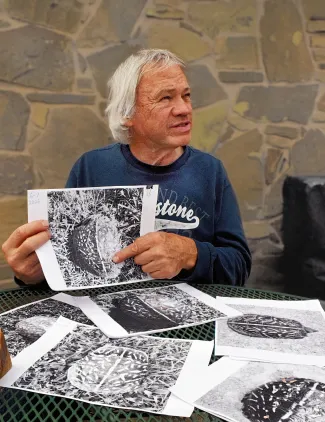
Piedmont resident Thomas Hall points out identifying marks on photos of ornate box turtles he's captured in his yard over several years.
It was just an ordinary day in 2018 when Hall caught sight of a beautiful ornate box turtle that had found its way to his backyard. Maybe it was fate, but this particular turtle aroused Hall’s curiosity. Hall rummaged in his pocket for his phone and snapped a picture directly above the turtle’s shell to get a full image of the stunning dark canvas streaked with vibrant yellow while the turtle timidly peeked out from underneath its shell.
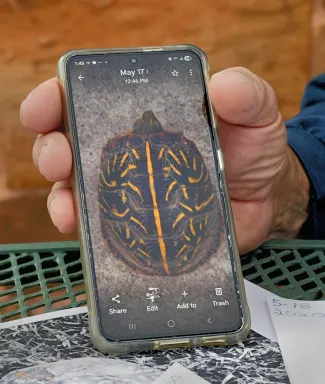
His mobile phone's camera allows Thomas Hall to document the turtles that traverse his yard near Piedmont.
With a bit of researching on the internet, he was able to identify the species and learned about the ornate box turtle. Individuals of this species usually live about 30 to 40 years, which made him wonder if this could be the same turtle that he had seen in his backyard in years before.
At first, his documentation was casual. He took a few pictures of turtles here and there. Then his mind changed once he realized he might be seeing the same turtle, and he started a collection of images of every turtle that showed up on his property.
What Hall is doing is not too far from methods that biologists in the field are using.
Scientists study animals by looking at individuals and entire populations. They use a variety of mark-and-recapture and tracking methods — in other words, doing what Hall does but on a larger scale. From big mammals to small invertebrates, figuring out “who is who” among individuals is essential for effective population monitoring, behavioral research, and informed conservation planning.
Traditional methods that have been used for monitoring include numbered ear tags, injected tracking devices, and other techniques considered invasive and possibly harmful to individual animals.
When Hall was a child, he saw people using fingernail polish to mark turtles, a method he wanted to avoid. So, he decided that photographic identification would fit the bill. “I thought this is a very noninvasive way of kind of studying them as a backyard biologist kind of thing,” Hall said.
Visual Proof
Similar photographic identification methods are being used by wildlife researchers here in Oklahoma. Snapping periodic pictures of the black and yellow thigh patterns of Cope’s gray tree frogs and the giraffe-like patterns on the backs of crawfish frogs have been highly successful for identifying individuals within larger population surveys. Adopting photographic identification curtails the use of more harmful traditional methods of identification and just might become the favored practice for tracking species such as the ornate box turtle!
Hall’s method is noninvasive and also easy for anyone to practice if they are interested in doing something similar.
The ornate box turtle has a camouflaged appearance with yellow dots and streaks scattered across its dome-shaped shell. But with a closer look, unique markings can be spotted through comparison between pictures.
Hall’s method is to locate an uncommon pattern in the markings. He focuses on one area of the shell and searches for any subsequent sighting of a turtle with the same pattern in the same location.
Hall said he likes to imagine features of faces within the turtle’s markings; some markings look like two eyes or eyebrows. It only takes a few minutes to document what he needs to ID the turtle.
He has noticed many of the turtles he’s seen over the years are the same ones. He’s even seen a shell go through a repair process over four years. While patterns can get a little tricky, observers can grab another set of eyes by uploading photos to community-based apps like iNaturalist to get help with identification and specific questions.
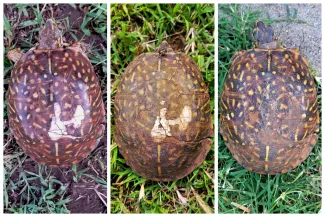
Hall documented this specific turtle from 2021 to 2025, showing how a damaged shell healed over time.
“I would have given anything if I would have started this when I first moved here” 33 years ago, Hall said.
Ornate box turtles are seen more frequently during spring and summer months, but they can appear almost any time of the year. These turtles tend to go to areas with plenty of food like June beetles and cozy places to burrow when the temperature starts to drop.
Hall said if he sees a turtle making its way under a pile of pine needles, he will leave it alone. His goal is to observe them while causing as little disruption as possible. A turtle might need to be picked up and moved out of a clearly dangerous situation. Hall’s only close physical interaction with a turtle was when he was lawn mowing and had to move a turtle about 20 feet away from where he was mowing.
Hall hopes his backyard research might inspire others — especially youngsters — to take up similar projects in their backyards. He offered some advice for people who want to start observing a particular species: Prepare ahead of time by reading about the species’ habitat preferences, its potential seasonal movements, and other facts that might point them in the right direction. Reading scientific articles, scanning through field guides and keeping personal notes are all great options to hone wildlife viewing skills.
“For people like me that live on little acreages, it would be something fun for kids to record, especially if you started some of this when they’re young,” Hall said. “And getting the neighbors involved promotes better community connections.”
With a cellphone camera and some knowledge about turtles, anyone can enjoy local turtle photography for years to come. Hall’s kids and grandchildren are already taking part as he shows them how to go about photographing the reptiles and teaching them the proper way to do so.
This story first appeared in the May/June 2026 issue of Outdoor Oklahoma. View back issues and subscribe here.