Samuel Henderson, 11, is autistic and takes special education classes at Nicoma Park Elementary. “He’s labeled, but he can excel,” his mother, Lori, said. “Nothing holds him back.”
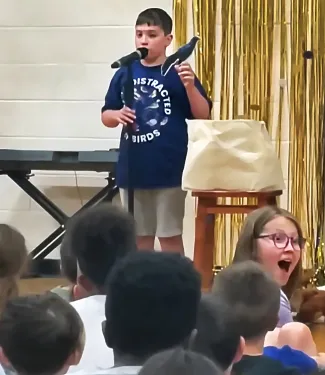
So when the school’s annual talent show rolled around last year, Samuel wanted to demonstrate his unusual talent. But his mom was concerned. Samuel had never been in front of the whole student body, and Lori was concerned that Samuel could end up being the object of ridicule for his talent.
Samuel sounds like a bird. Actually, he is able to sound like about 60 different types of birds.
The students were amazed, and Samuel quickly became the school’s celebrity. And it wasn’t long before he was a national celebrity as well.
Lori posted her cellphone video of Samuel’s performance on social media, and it wasn’t long before it went viral and inquiries started coming in. Audubon magazine was the first national outlet to feature Samuel. Then there were the Oklahoma City news channels, “CBS Evening News,” National Public Radio, “The Jennifer Hudson Show,” and others.
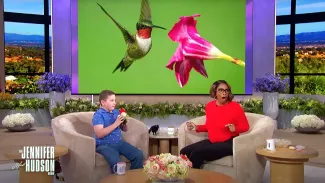
Lori said even Cornell University has reached out, inviting Samuel to take a tour of the campus for his future consideration.
“I’ve been involved with birds for six years,” he said. “When I was 4, and I was at my local zoo. And there was this great-tailed grackle on this trash can. And I started mimicking it.” At this point, Samuel starts emitting a sound that a listener would swear is coming from a bird.
The sound isn’t made with the lips, like a whistle. It comes from inside Samuel’s mouth, and from his throat and vocal chords. Asked how he learned to perform birds calls, he said, “Well, yeah, I don’t know really.”
His mom had always been the birder of the family. But as Samuel grew, his interest in birds grew. He began studying different bird calls using the Merlin app, and bird watching. “My favorite place to bird watch is Grandma’s house; she has painted buntings!”
Samuel’s avian imitations range from geese to crows, cardinals to chickadees, and many more. He said birds make differing calls for various reasons.
“Well, so, there’s different meanings, like to keep in touch, to warn … and also to display, to get a mate. I’m easily distracted by birds — and also I’m pretty much distracted by those chickadees,” he said, looking over into a nearby tree.
Samuel said he’s interested in having a career in ornithology or conservation. So, Outdoor Oklahoma invited Samuel and his mom to take a short birding trip with Mark Howery, a Senior Wildlife Biologist with the Oklahoma Department of Conservation. Howery likely is the greatest bird expert with ODWC.

“I’ve been birding, goodness, I started around fifth grade. So I was around 9 or 10 years old. Though I’ve never learned the bird calls like Samuel has, he’s learned a tremendous number of bird calls.
“I really was all about the appearance of birds for the first 10 years or so. And then about the time I got into college, I started learning the bird songs. I had to pick those up gradually because to me, the bird songs are the hard part.
“I can’t even imagine trying to imitate them. There might be three birds I could imitate, and none of them as well as he can.”
With that, the biologist and the boy headed off along a forested path, binoculars in hand, to do some bird watching — and calling. A few seconds later, and Samuel got excited upon hearing a certain pattern of chips. “There’s a tufted titmouse!” He turned to Howery.
“OK, I want to see if you know this sound. Mom, you probably know this sound, but don’t tell him.”
After Samuel was done, Howery guessed, “Are you doing the greater roadrunner?”
“Yes,” Samuel said. “So what do you think about that?”
“I’m impressed. Greater roadrunners have a couple of different calls. But he was doing the main call. It’s this ‘coo’ that goes on for like 9 or 11 beats.”
The pair continued walking, sighting various birds, and Samuel kept producing various bird songs.
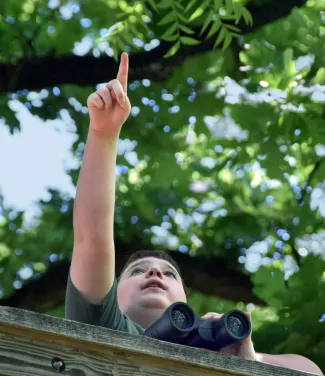
“I didn’t have the skill for bird songs,” Howery recalled. “Samuel did an excellent robin and an excellent summer tanager. And those are hard, very hard.
“With all the bird calls that you’ve made, I mean, I have no doubt that you’ve seen — I’m sure you haven’t added them all up — but I bet you’ve seen well over 150 species because it sounds like, just from the diversity of calls that you know, from collared dove to eastern meadowlark, that’s a reflector.”
Then something caught Samuel’s attention, and Howery said, “That’s a Carolina wren. There’s also a blue-gray gnatcatcher up here that’s real quiet. That little skinny bird. There’s a pair of them.”
“It’s a lifer bird,” Samuel said
“That’s a lifer bird for you?”
“Yeah. Umm, it’s a bird that you’ve always wanted to see.”
Howery explained, “Birders keep a list. A lifer bird is when you, just like Samuel said, when you see a bird you want to see and you’re seeing it for the first time.”
Howery has some tips for anyone wanting to take up birding.
“For anyone that’s starting out in birds, I always say get a field guide or two that you like to help you identify the birds you’re seeing. I’ve got a bunch of field guides. There’s not a bad field guide out there for birds.
“Field guide, binoculars, and just practice watching birds. A lot of people start watching birds at a backyard bird feeder. That’s the way I was. The first probably five years that I watched birds, it was just winter birds at the backyard feeder.
“I guess other advice I would have is find a place that you’re comfortable, like a park. It doesn’t have to be any place fancy. It can just be a city park. It can be a lake. Someplace that’s kind of quiet. And just look and listen for birds.
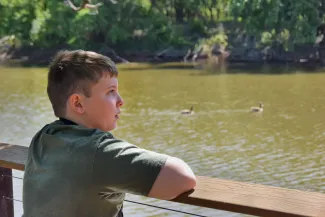
“Some of the birds are going to be very … cooperative birds. Like cardinals are usually pretty cooperative. They’ll sit out in the open, and you can hear them. Other birds like painted buntings, they cooperate in the sense that they’re really vocal. You can hear painted buntings a lot, but they’re hard to find. You’ve got to be really patient with them.”
“Today, people have access to the internet, so you can see videos of birds to learn calls and learn identification. Then you’ve got the Merlin app that helps people identify birds by song and by sight. Really, to learn birding, it’s just practice and repetition.”
Samuel agreed. “I think anybody can pick up birding. It’s just a matter of patience.”
On this day, patience paid off, as the pair tallied at least 20 bird species in just a few hours. Among them were a Mississippi kite, brown-headed cowbird, great-tailed grackle, blue-gray gnatcatcher, hummingbird, Northern cardinal, red-tailed hawk, fish crow, white-faced ibis, Eastern kingbird, great-crested flycatcher, Carolina chickadee, tufted titmouse, Canada goose, red-bellied woodpecker, Lincoln sparrow, great blue heron, mourning dove, dark-eyed junco and Carolina wren.
“He knows his birds,” Howery said.
Mother, Lori, said she hopes her son will continue to spread the word about wildlife conservation and, of course, birding. But she also hopes that Samuel’s love for birds can inspire others to nurture and grow in their passion, too, whatever that might be.