
If you are of a certain age, reading the “MEEP! MEEP!” instantly transports you back to a 6-year-old version of yourself on some Saturday morning, watching ol' Wile E. Coyote trying to outsmart the Road Runner with the help of some new gadget from the ACME Corporation. Ultimately, Wile E. Coyote would be outsmarted, and the ACME product would backfire.
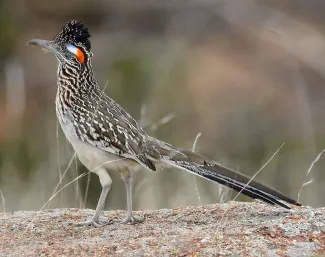
But I'm not here to talk about that roadrunner, instead the real bird that inspired this cartoon representation.
This desert specialist, x-footed, fast-running, mini velociraptor-looking, ground bird must be one the coolest of our native birds, and a real favorite of yours truly. Now, let's get into it.
The ground-dwelling roadrunner, built for speed while running versus flying, is an atypical member of the cuckoo family (Cuculidae) and has two species, the greater and lesser. In this article, we will only be discussing the greater roadrunner (Geococcyx californianus) as this species is endemic to the Sooner State. So, from here on, if I say roadrunner, I mean the greater roadrunner.
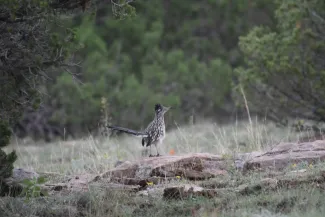
An adventurous person may find the roadrunner throughout the deserts, grasslands, and shrublands of the American Southwest and Mexico, and in more recent years, Missouri and Louisiana, as these birds are expanding their range more eastwards. If you’re driving down just about any quiet gravel road in our state, keep your eyes open, as roadrunners will offer a nice surprise as they dart in and out of cover (cedar trees in the fence line in my experience) while hunting for prey. I see them very frequently, making it feel as if they are common birds, but they can be very difficult to find on the edges of their range.

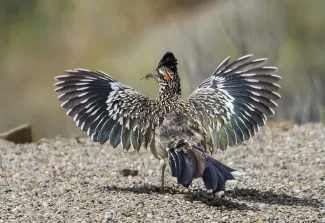
They possess not only great speed, but also have spectacular camouflage; their feathers are a mottled mix of brown, black, and white, but also have a beautiful iridescence when the sunlight hits their outstretched wings.
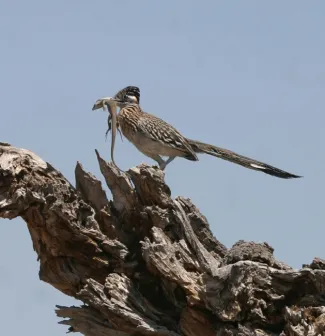
Roadrunners are omnivores in the true sense; they forage on everything from rattlesnakes to poisonous frogs to seeds. Their typical diet includes mostly animals, including almost anything they can catch - small mammals, reptiles, frogs, toads, insects, centipedes, scorpions, and birds. Roadrunners also eat carrion and prey on bird eggs and chicks. They kill rattlesnakes by pecking them repeatedly in the head. Yes, you read that correctly, rattlesnakes. Typically hunting in pairs, one bird will distract the snake while the other pecks the snake's head from behind before grabbing it and slamming it into the ground. They have also been observed slamming large prey, such as rodents and lizards, against a rock or the ground multiple times to break bones and elongate the victim, making it easier to swallow whole.
If a prey item is too long to completely consume (like a snake), they will allow it to hang out the side of their mouth until it is partially digested and more may be swallowed.
These opportunistic predators have also been known to grab birds from backyard feeders or nest boxes. In winter, fruit, seeds, and other plant material make up 10 percent of the roadrunner’s diet.
Roadrunners typically form lifelong pairs that they renew each spring with elaborate courtship displays. They build a shallow nest of twigs, leaves, and grass. Males will bring twigs to the female for her to form into the nest. A male that pauses for too long in his stick gathering may get reminded with a whining call from his partner, prompting him to get back to work.
Clutch size ranges between two to six eggs that are incubated for 20-25 days by both partners.
When mating, the male roadrunner leaps onto his partner’s back while holding a mouse or other food offering, which both partners grasp as they copulate. Afterward, he circles his mate, bowing, cooing, and flicking his tail in a stylized display.
Chicks are altricial, meaning they are born helpless and require extensive parental care. Both parents feed the chicks insects and other small prey. The chicks fledge, or leave the nest, after about 20 to 25 days, but they continue to rely on their parents for food for several weeks. In the wild, roadrunners can live up to 7 years.
Both partners will patrol their territory, which can be up to a half mile in diameter, with males perching on top of rocks or fence posts, calling a mournful “co-coo-coooo” to signal territory boundaries.
Being adapted to the harsh desert environments, roadrunners secrete a solution of highly concentrated salt, much like sea birds, through a gland just in front of each eye, which uses less water than excreting it via their kidneys and urinary tract. Moisture-rich prey supplies them with otherwise scarce water.
Long before Richard Petty took the checkered flag at Daytona with that number 43 blue Plymouth Superbird, Plymouth named their car for Wile's arch nemesis. The real roadrunner was serving as a cultural icon as far back as 700 AD to the Pueblo tribes of the ancient American Southwest. The birds were revered for their courage, strength, speed, and endurance. The roadrunner’s distinctive X-shaped (zygodactyl feet) footprint — with two toes pointing forward and two backwards - was used as sacred symbols by the Pueblo tribes to ward off evil. The X shape disguises the direction the bird is heading and is thought to prevent evil spirits from following.
They do serve an ecological role not only to keep those prey populations in check, but also as a food source for other predators like hawks, owls, and yes, even coyotes. Though Wile never could catch the Road Runner, real coyotes run up to 43 mph, almost double what the greater roadrunner can run, meaning that in real life, the coyote is one of their major predators.
Hopefully you now can understand why this camouflaged yet colorful, evil-spirit confusing, bad-to-the-bone, rattlesnake-killing, living-life-on-the-edge avian rockstar is one of my favorite birds. So, use this as a reminder to live life on the edge a bit and get out there and find one of these remarkable birds.