
Description
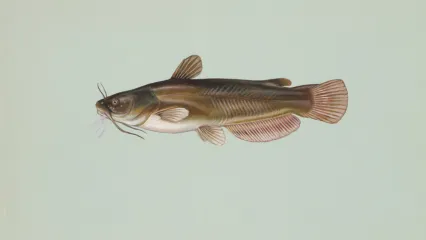
Yellow bullhead catfish (Ameiurus natalis) are distinguishable through their barbells that are located near the corners of their mouths, broad head, spiny caudal and pectoral fins, and for having no scales. Additionally, compared to the channel catfish and blue catfish, bullhead catfish have squared tailfins rather than forked. Adults are yellow to olive-brown on its back and sides, fading to a pale yellow or white belly. The barbells can be white or yellow, but the color on their bodies vary depending on their location.
Facts: Bullhead catfish are incredibly resilient as they can tolerate extremely low oxygen levels, high pollution, and can even survive outside of the water for several hours! They also pack a mighty punch with a sting from their fin spines.
Size
The size of the yellow bullhead catfish ranges from a length of 7-13 ½” and a weight of 0.2-1.3lbs.
Habitat
Yellow bullhead catfish are bottom dwelling fish and are typically found in vegetated, clear, and in or near streams with permanent flow (similar to other bullheads, it avoids strong currents) such as backwaters and overflow pools.
Food sources: Bullhead catfish are omnivorous bottom feeders that eat almost anything. They have a keen sense of smell to detect food but primarily feeds on crayfish, amphipods, snails, plant material, and occasionally small fish.
Life Cycle
The life cycle of a bullhead catfish starts at spawning in late spring to early summer (May-July). In shallow, warm waters, the females build nests in a saucer shape which can be found under logs, in vegetation, or on shallow banks. The females lay a range of 50-10,000 eggs once per season. The time it takes for the eggs to hatch depends on the temperature but the average time takes about 6 days. After hatching, one or both of the parents guard the newly hatched fry and chase away predators or other fish. The average time the fry spend in parental care is about 29 days. Following the fry’s newfound independence, they can expect to live about 5 years in the wild.
By Kinsey Matlock - Dec. 16, 2025