
Description
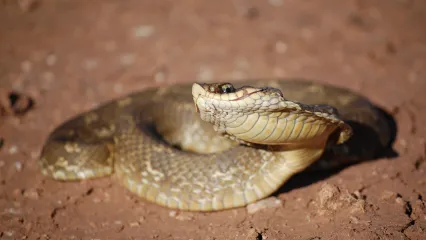
Western pygmy rattlesnakes are relatively small-sized pit-vipers with a tiny rattle on the tail. Like other pit-vipers, they have elliptical pupils in the eyes and heat sensory pits located below and between the eye and nostril. They can be distinguished from other rattlesnakes by a combination of small size, the tiny rattle, and a gray body with a series of distinct black spots along the midline of the body and a series of black spots along each side. Scales on top of the head are large when compared with scales on top of the head of western diamond-backed rattlesnakes and timber rattlesnakes. A mid-dorsal stripe that is orange to orange-red runs down the midline of the back, somewhat similar to that found on timber rattlesnakes. Similar to other pit-vipers, dorsal scales are heavily keeled and scales under the tail are complete whereas the same scales on most nonvenomous snakes are divided. Western pygmy rattlesnakes may be confused with juvenile timber rattlesnakes and eastern hog-nosed snakes. Western pygmy rattlesnakes have a rattle, eastern hognose snakes do not. Eastern hog-nosed snakes also have a distinctly turned up nose and round pupils in the eyes. Eastern hog-nosed snakes vary greatly in color and pattern, and some individual resemble western pygmy rattlesnakes in coloration.
Size
Large adult western pygmy rattlesnakes rarely exceed two feet in total length and most adults encountered are 16 – 18 inches long. Newborn offspring are about six inches in length.
Habitat
Western pygmy rattlesnakes are nearly always associated with forest habitats, including eastern deciduous forest and riparian woodlands. They are largely absent from patches of prairie in the eastern part of the state. Rock outcrops do not seem to be a requirement for these diminutive rattlesnakes as they are common in the mixed oak forest of the Cross Timbers Ecoregion in Oklahoma in many areas lacking rocks.
Life Cycle
These snakes are active from March through November, depending on the temperatures. During spring and fall, they are often found active during the day, but during summer, their activity shifts to late afternoon and night. Western pygmy rattlesnakes feed on a wide variety of small vertebrates, including mammals, lizards, snakes, frogs, and salamanders.
Similar to other pit-vipers, these snakes are late-maturing, long-lived and produce multiple litters during their lifetime. Western pygmy rattlesnakes mate in fall or spring and females likely can store sperm. Birth of live young occurs in late August or early September. Most females reproduce every other year. Litters vary with the size of females, usually varying from 6 – 13 offspring.
How To Observe
These venomous rattlesnakes are cryptically colored and usually lie motionless on the forest floor. As a result, they are extremely difficult to observe.