When landowners start down the path of building a farm pond, many ideas and online searches come into play – but the question of where to start comes to mind.
When I talk with landowners about building a pond, the take-home points that I give them are simple; have a budget lined out, plan accordingly, and overall, have fun with the project. Don’t let overwhelming information online weigh down decisions of what you want out of your pond, and the way to achieve that goal. Keep it simple, and it’s a waiting game.
The early stage starts with the ideal location of where to construct a farm pond. Folks should look for a drainage or low-lying area that holds water; this can be achieved by walking your pasture and looking at topographic maps or aerial images of upstream ponds in a drainage (try to avoid areas with high agriculture or residential uses to avoid runoff that could cause future fish kills). Once you find the “perfect” location, develop the idea of what you want out of your pond. It’s as simple as getting a piece of paper to draw your ideal pond shape and make a list of goals to achieve.
This is the biggest part of the “planning phase.” When drawing out your pond, make sure to incorporate various depths, fishing access areas, habitat locations, spillway/drawdown structure, bank slopes, and a dock if desired.
Planning ahead will help you to better foresee the final product, helping you not to overlook any important components once construction is finished.
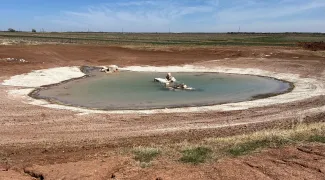
A basic fishing pond should be a one-half to two-acre watershed with a depth of at least 10 feet; the concept of pond size allows fish to have an adequate amount of usable space and to account for dry or drawdown periods when water levels are low. An irregular shape is good to incorporate due to maximizing shoreline for desired species such as bass and sunfish.
Most banks should be steep, a 3:1 slope (three feet of width for every one foot of height) to a depth of three or four feet. This will help to control unwanted vegetation while providing increased shoreline fishing access.
The most overlooked aspect of building a new pond is habitat. Habitat can consist of many shapes and forms – cedar trees, hardwood trees, large rocks, riprap, gravel areas for spawning, and spawning structures for catfish (capped PVC, large rocks… anything that serves as a cavity). Anything is better than nothing for habitat. When placing trees, anchor them with cinder blocks or cement to keep them in place and from floating. Make spawning beds in shallow areas with gravel or rock; spawning cavities should be two to four feet deep, and have adequate habitat at various depths throughout your pond for any condition, and for larger fish to occupy.
Advanced planning and designs are the “bones” of your pond, and having them in place will help maintain a healthy fishery and will be easier to do when water is not present.
Now, the wait begins; waiting for water to fill your new pond, the wait to stock desired fish, and the end goal of casting a line. While waiting for your pond to fill and settle in, take that time as a luxury to take pictures of where things are, add or remove structures you may have not planned for, and plan the next phase of what species of fish you want in your pond – along with management goals you plan to achieve. This is a great time to establish shoreline vegetation, research farm pond management goals, and future planning of what to do next (future stocking regimes, effective ways to assess your farm pond for fish health, maintain dam integrity, and note improvements such as adding more brush after 10 years). The waiting period can seem to be the longest, but it is the chance to think ideas over and possible improvements to your new system.
Each step in building a farm pond is a cookbook for a productive system that you have invested in. Remember, your farm pond is a living organism in itself, and each step is crucial to maintain a future fishery. And it doesn’t stop once you have stocked fish. Always be vigilant and take notes on your pond’s health, ask questions, reach out to ODWC staff for help… and remember to have fun with the process as it’s your new “perfect” pond.
Please reach out to Oklahoma Department of Wildlife Conservation Fisheries Division staff to help you with any questions or concerns about your farm pond.
Fisheries Division
Oklahoma Department of Wildlife Conservation
PO BOX 53465
Oklahoma City, OK 73152
(405) 521-3721