At face value, this question seems to point to an obvious and resounding - yes. But when we look more closely at what a truly “pure” grass landscape provides, compared to the structure of a balanced habitat, that answer quickly becomes ‘it depends’… and rarely a true yes.
When most people imagine something “pure,” they generally picture 100 percent of a single thing or type, but in an ecological context, we call that a monoculture; and oftentimes that is not a good thing.
Before we dive deeper, it also helps to define what we mean by grassland. Generally, grasslands are areas dominated by primarily grass species; but to a northern bobwhite, not just any grass will do. Here in Oklahoma, many so-called “improved” grasses like Bermuda, Johnson grass, and fescue were introduced to increase forage production for livestock. These species often grow in dense uniform stands that reduce plant diversity, negatively impact the water cycle, and limit how and where quail can forage for food.
When you hear the term “pure grassland,” it’s easy to imagine a lush green field like a wheat field; a large area dominated by a single species. From a quail’s perspective, any large expanse of one plant type offers limited value when compared to a more naturally diverse alternative.
Quail thrive in balanced native ecosystems, where plant diversity creates food and cover throughout the year. Maintaining a truly “pure” grass stand often requires removing what many call weeds, but those “weeds” are frequently native flowering forbs. While they may not always benefit cattle directly, those plants play essential ecological roles. There are certainly situations and invasive species that require intervention and management, but in many instances those “weeds” don’t need to be sprayed.
Flowering plants attract pollinators and other insects. After pollination, those plants produce seeds. Those insects and seeds are foundational food resources for quail, especially for those growing chicks that rely heavily on insects.
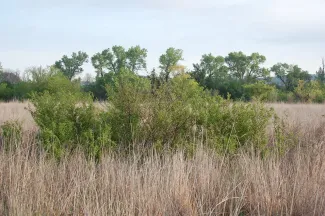
Quail need more than grass alone. They need diversity: native legumes like Illinois bundleflower that enrich the soil with nitrogen, deep-rooted native forbs and grasses that work to stabilize the soil and improve drought resilience, shrubs like sand plum and sumac that provide escape and loafing cover, native bunch grasses for nesting, and a wide range of native flowering plants that support insects and produce seed. If a large block of land is 100 percent grasses, it simply isn’t quality habitat for quail or other wildlife.
If you, as a land manager, have a fixed number of acres and must choose between pure grass pasture and a diverse community of native grasses, forbs, and shrubs, the answer is clear: quail, other wildlife species, and even livestock will benefit far more from the diversity of a balanced habitat.
Check out ODWC’s Landowner Programs to learn how you can improve your property for quail and other wildlife species.