Managing Oklahoma’s fish and wildlife is the Wildlife Department’s driving purpose. We’ve compiled a few of the state’s habitat and species management wins in 2026, providing snapshots of how the agency’s 350 employees rallied to meet the honored conservation mission.
Managing Oklahoma’s fish and wildlife is the Wildlife Department’s driving purpose. In 2026, biologists across the state conducted surveys, worked to improve habitat conditions, and partnered with colleges and universities to learn more about our natural resources. Education specialists offered lessons in safe hunting and shooting techniques and helped several Oklahomans catch their first fish. Our communications team shared those stories and kept you updated on the state’s many outdoor opportunities. Administrative staff sold licenses, processed invoices, managed grants, and kept our doors open for business. And game wardens enforced Oklahoma’s hunting and fishing regulations, ensuring harvestable populations remain in the state and that license revenue is collected to support long-term conservation efforts.
Prescribed fires were planned and lighted. Ducks and geese were trapped and banded. Antlers were scored. Wings and otoliths were aged. Hooks were baited and first fish were caught. Wildlife violations were investigated. Research teams supplied data on wild turkeys, pronghorn, lesser prairie-chickens, black-capped vireos, and invasive carp. Partnerships were forged with landowners to improve thousands of acres of privately owned habitat. These are just a few snapshots of the many conservation efforts made in the past year. All as part of our conservation mission to manage and protect fish and wildlife, along with their habitats, while also growing our community of hunters and anglers, partnering with those who love the outdoors, and fostering stewardship with those who care for the land.
2026 At a Glance
- Reclaiming Habitat
The Wildlife Department manages nearly 100 Wildlife Management Areas, representing more than a million acres of habitat from the high plains to the coastal plains. More than 48,000 of these acres were burned in 2026, with prescribed fire bosses dodging both floods and droughts. These methodically planned burns boosted prairie and forest habitat and were used in conjunction with mechanical and chemical treatments to reclaim nearly 7,500 acres of habitat that had been invaded by eastern redcedar.
- Catch of the Day
Biologists regularly catch, tag, and release fish with hopes that at least some of those fish are either recaught by survey teams or reported by anglers. These recaptures not only help biologists learn about the population size and structure but also can shed light on a fish’s loyalty to spawning sites and its movement patterns. Three fish tagged in the Grand Lake O’ the Cherokees as part of two different studies showed back up this year, making quite an impression:
- A flathead catfish tagged as fish #0003 on July 16, 2024, in Grand Lake’s Honey Creek Arm was recaptured by a survey team on July 15, 2025, about one mile from its 2024 location. The fish was again recaptured in the same area as in 2025 on July 14, 2026.
- Another Grand Lake flathead tagged in 2025 traveled 89 miles upstream — across two low water bridges and the state line — and was caught and reported by a Kansas angler on the Neosho River.
- A male paddlefish tagged in Feb. 2003 was at large for more than two decades before being recaptured by a survey crew this January! The fish had what appeared to be a scar from a boat strike but no obvious hook scars.
In addition to catching and tagging fish, the Wildlife Department also produced and stocked nearly 10 million fish in 2026, representing 11 different species, in 97 water bodies statewide.
Upload your own catch-of-the-day on The Dock, at wildlifedepartment.com.
- Fish Tales and Other Outdoor Stories
We love sharing stories about the state’s fish and wildlife and the conservation-minded people that continue Oklahoma’s proud hunting, fishing, and outdoor traditions. Each year, we bring these stories to life in our Outdoor Oklahoma magazine and television show, in newsletters and emails, as well as on our social media channels. Favorites from 2026 include:
- Bear Aware: This episode covers two very different kinds of bear stories. First up, we explore responsible actions that can help people and bears coexist. Then, archer Caleb Flies takes primitive hunting to an extraordinary level, using equipment he built entirely by hand!
- How a Love of Fishing Led to a Life on TV: We hit the water with Meteorologist Lacey Swope to talk about her passion for fishing, how weather impacts your success on the water, and why Oklahoma is one of the best places in the country to cast a line.
- Level Up Your Bird Watching Experience: As with most hobbies, bird watching interests and skill levels can vary, and each birder can chart their own course. The one constant? There’s almost always a bird to watch. We cover everything from bird identification basics to birding by ear and finding your next birding hotspot.
- When Private Land Goes Public: We discuss the ins and outs of the Wildlife Department’s Oklahoma Land Access Program, from the limited access and check in features to the different species available to hunt and fish across the 91,000-plus acres enrolled in the program.
- Warden Life
ODWC employs 120 game wardens across the state who do more than just enforce wildlife laws. They are educators, conservationists, and community liaisons who work every day to manage natural resources, assist landowners, support sportsmen and women, and promote safe and ethical outdoor practices.
In the last 12 months, they have conducted more than 56,000 compliance checks, hosted 2,880 outreach and education clinics, and spent more than 17,000 hours assisting the public and other ODWC staff. More impressive stats include:
- 2,173,654 miles driven
- 95,970 patrol hours
- 18,427 training hours
- 6,993 investigative hours
- 2,004 citations issued
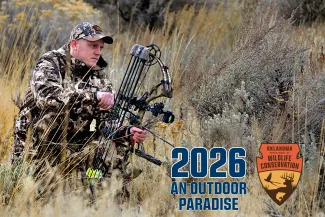
Hunters and anglers tapped into liberal seasons and bag limits in 2026 and made great use of the Wildlife Department’s 1.3 million acres of public hunting and fishing lands.
Oklahoma is known as a top-tier outdoor destination thanks to the Wildlife Department’s dedicated workforce and engaged hunting and fishing community. To ensure Oklahoma’s hunting and fishing opportunities are available for generations to come, the Wildlife Department intentionally manages game species and habitats, with biologists and game wardens working to set and enforce fair yet progressive regulations. Hunters and anglers made the most of 2026, tapping into liberal seasons and bag limits and making use of the Wildlife Department’s 1.3 million acres of public hunting and fishing lands.
- Harvest by the Numbers
- The state’s second highest recorded deer harvest wrapped in Jan. 2026, with 133,791 total deer checked during the 2025-2026 season. The harvest also included several high-scoring entries into the Cy Curtis Award Program, with multiple nontypical deer scoring in the 200s and typical entries scoring more than 150. To top it off, hunters did their part in helping maintain a balanced herd by harvesting antlerless deer, which accounted for 45% of the total harvest. Read more in the 2025-2026 Big Game Harvest Report.
- Despite the very hot and very dry opening to the 2026 archery season, the ongoing 2026-2027 deer seasons have also had strong harvest numbers. Prior to the opening of regular deer gun season, one of the most popular hunting opportunities, more than 42,000 deer had been checked across the state.
- Upland game hunters also saw success in 2026; more than 10,250 wild turkeys were harvested in this year’s spring and fall seasons. Roger Mills County, home to Black Kettle WMA, had the highest harvest in the state with 565 checked birds.
- Hunters also set a record by harvesting 147 black bears in 2026 and further upheld Oklahoma’s reputation as a premier destination for hunting.
- Casting a Line Got Easier at Several Popular Spots
Several public fishing areas got upgrades in 2026! Key features included wider boat ramps, increased parking, ADA-compliant walkways, restrooms, new courtesy docks, jetties and even a paddlecraft launch area at Lake Bixhoma.
Future fishing access projects include installing a new fishing dock at Medford Public School’s Outdoor Classroom, Veterans Park Pond in Newcastle, and Ten Acre Lake in Choctaw. Boating access projects will also continue with several lakes receiving courtesy docks, ADA parking, and walkways.
- National Hunting and Fishing Day Recognized in Oklahoma
Nearly 1 million sportsmen and women contribute to conservation in Oklahoma, and their rich hunting and fishing traditions were recognized by Governor Stitt this Sept. 26. The Wildlife Department does not receive any state-appropriated tax dollars for its conservation efforts. Instead, hunting and fishing license dollars unlock a pool of federal grants generated by excise taxes collected on certain hunting and fishing equipment purchases. Other licenses like the Wildlife Conservation Passport and revenue from agricultural and oil leases can also be used to match federal grants.

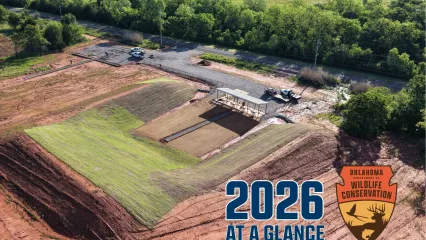
Construction and renovations were completed at four Wildlife Management Area shooting ranges this year! Hone your skills at these and other hunter- and angler-funded facilities.
The Wildlife Department wants you to be ready for the next hunting, fishing, or wildlife watching opportunity that comes your way. That’s why we hosted dozens of in-person classes designed to help you learn to hunt and trap, tackle the basics, level up your birding experience, and set your sights on safety. (Attendees told us how much they enjoyed learning through action in 2026, so we’ve scheduled more workshops and events for 2027! Details will be at Go Outdoors Oklahoma as well as in your inbox and feed…) We know it can be tough to fit even one more activity into an already packed calendar, so we’ll continue to drop new episodes of our popular series Reel Talk Real Tips and Learn to Hunt for you to watch at home or listen to on the go.
Picking up a new skill is just one part of the outdoor education equation — repeated practice is what can turn that skill into a successful hobby. That’s especially true for shooting sports, so the Wildlife Department has continued to prioritize providing quality places to practice your aim and prep for the next hunting season. A new shooting range was completed this year at Copan WMA in northeastern Oklahoma, and existing ranges were renovated at Canton, Lexington, and Pushmataha WMAs in northwestern, central and southeastern Oklahoma. Your hunting license grants access to these new and renovated ranges, as well as the Wildlife Department’s 12 other ranges statewide.
- School’s In Session
Teachers at more than 500 public and private schools have been trained to bring archery, bowhunting, shotgun shooting, and fishing into their classrooms and are now training the next generation of skilled outdoorspeople! In 2026, more than 50,000 elementary, middle, and high school students went through the Wildlife Department’s in-school education programs, and another 3,500 participants were introduced to shooting sports through the Shotgun Training Education Program.
Ways to Support Conservation
The Wildlife Department’s 350 employees are honored to work not only for the resource but also the state’s dedicated outdoor community.
Our conservation work can be supported in the coming year in a number of ways, from buying a hunting or fishing license to making a purchase in the Go Outdoors Oklahoma shop, ordering a wildlife conservation specialty license plate, or making a direct donation. Financial support helps put conservation plans into action, but there are other great ways to support conservation in Oklahoma! Hunters and anglers can mentor incoming conservationists. Naturalists can share their fish and wildlife sightings on free platforms like eBird and iNaturalist. And everyone can share about Oklahoma’s incredible species and conservation actions.
Thanks for letting us be your Oklahoma Department of Wildlife Conservation.