
Jocelyn Howell has spent her USDA Forest Service career managing habitat to benefit the red-cockaded woodpecker and monitoring the bird’s populations across multiple states and administrative districts. As part of her day-to-day work, she has regularly heard the federally threatened bird’s high-pitched call, a sound that reminds her of a squeaking dog toy 🔊. When she heard that familiar squeak last spring in Le Flore County, Okla. – miles from the nearest known population – she had no doubt it meant something special.
“When you hear that squeak nearly every day for 15-plus years, it’s in your head,” Howell said, referring to her years spent working within the woodpecker’s range. “It was unexpected [hearing that sound in Le Flore County], but I knew a red-cockaded woodpecker was in the area.
“I heard two birds calling to each other and eventually saw one of the birds – the first to be documented in the county in recent history. As soon as I heard that sound, I was so happy. It was the greatest feeling – Le Flore County had its first bird.”
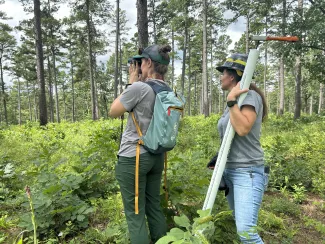
Howell was first introduced to the woodpecker’s distinctive sound in 2007 while volunteering at the Sam Houston National Forest, north of Houston, and followed the squeak to her first official Forest Service posting there in 2008. She later trailed the call and the associated conservation work to the Davy Crockett National Forest in East Texas, back to the Sam Houston National Forest, and eventually to the Ouachita National Forest – first in Arkansas’s Jessieville Winona Fourche Ranger District in 2020 and then to the Oklahoma Ranger District in 2022.
Regardless of her location, the red-cockaded woodpecker has been at the heart of her work.
“Red-cockaded woodpeckers operate in such a tight family unit and have such an interesting family dynamic,” Howell said. “They mate for life – remating if their original mate is lost – and older males from previous clutches will stay with the nesting pair as ‘helper birds.’ A lot of birds just don’t put that much energy into the next generation.”
More about red-cockaded woodpeckers
In a happy twist, Howell’s red-cockaded woodpecker-filled career has come full-circle in Oklahoma. Birds she handled at the Sam Houston National Forest as part of a translocation effort were moved to the McCurtain County Wilderness Area and Ouachita National Forest, Oklahoma Ranger District in 2017. At least one of those translocated birds has been confirmed to remain and nest in Oklahoma.

This story of discovery comes on the heels of the U.S. Fish and Wildlife Service’s October 2024 Endangered Species Act downlisting of the woodpecker from federally endangered to federally threatened. The bird was first protected by the Act in 1970 as suitable habitat became more and more limited.
For decades, Oklahoma’s last remaining population of red-cockaded woodpeckers was thought to occur about 35 miles south of the newly discovered territory, at the Wildlife Department’s McCurtain County Wilderness Area and the neighboring tracts of Forest Service land. The two agencies – one state, one federal – have long shared resources to monitor Oklahoma’s small woodpecker population and maintain the open shortleaf pine habitat they require.
It was this kind of habitat work that led to Howell’s 2024 Le Flore County success story.
Return of the Woodpecker
In May 2024, Howell was scouting a 740-acre tract on the Ouachita Wildlife Management Area – Le Flore Unit that had been logged over a 10-year period, burned twice in wildfires, and was scheduled for “wildlife stand improvement.”
When national forest timber is harvested and sold, a majority of the collected money is used by the U.S. Department of Agriculture to fund its varied programs, including the Secure Rural Schools Program. But a small portion may be held in a trust to fund habitat improvement efforts in the area from which the receipts were collected.
On the Ouachita National Forest, this habitat work – or wildlife stand improvement – generally involves thinning the trees that have aggressively regrown after a logging event and measure under a prescribed diameter. Regrowth is a continuing challenge in southeastern Oklahoma, where rainfall totals average about 50 inches each year and woody vegetation thrives.
While surveying conditions for the upcoming habitat project, Howell immediately recognized the unexpected but tell-tale squeak of two red-cockaded woodpeckers. She was less confident about the birds’ origins. The nearest Oklahoma population was dozens of miles beyond the maximum 5 to 6 the woodpeckers are known to disperse from their parent’s tree cavities. But she knew an established population was within 10 miles, across the state line in the Ouachita National Forest’s Poteau/Cold Springs Ranger District near Waldron, Arkansas, with another population about 10 miles in a different direction, near Mena.
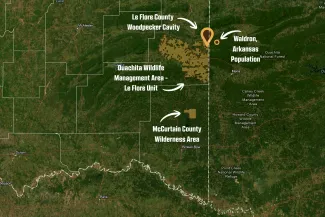
To get the scheduled habitat work in motion, Howell prescribed a deep thinning, confident the area had potential for red-cockaded woodpeckers. All the while, she kept an ear tuned for any birds foraging in the area.
“I absolutely fell in love with the area. I knew there was a good chance something could come of the work.”
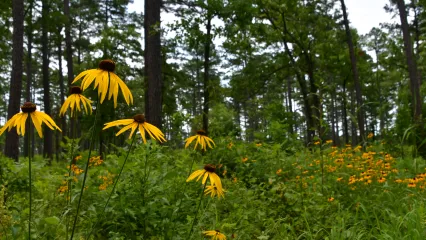
By July 2024, contractors were starting to remove hardwoods measuring 1-10 inches diameter at breast height and pines measuring less than 8 inches. All the vegetation between the remaining trees was mulched into small chips with a masticator, disturbing the soil and allowing sunlight to hit the ground. Instead of leaving the brush and slash on the ground where the cut trees would continue casting shade, mulching encourages wildflowers to sprout, which can boost the insect community and prey base for the protected woodpeckers.
As the thinning contract was getting underway, Howell made daily visits to the work site while also digging into the woodpeckers’ mysterious roots. Early on, she asked Forest Service colleague Warren Montegue about the nearest Arkansas cavity as the woodpecker flies. Initially, the closest occupied tree cavity was thought to be 7.5 miles from the work site. But Howell’s question spurred a renewed search in Arkansas that revealed an even closer cavity, located just at the edge of the 5 to 6 miles birds willingly fly to disperse. While the woodpeckers’ social nature and limited dispersal distances point to a strong connection to the Arkansas population, none of the birds observed in Le Flore County have identifying leg bands and their origin stories remain a mystery.
Woodpecker Surprise After Surprise, After Surprise
It was during Howell’s daily visits to the work site that she got a second woodpecker surprise. A male red-cockaded woodpecker had drilled a cavity in a pine tree within the treatment area, a process that can take birds more than one year to complete.
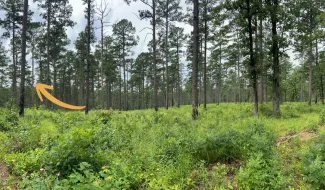
“Hearing birds foraging in a new area is one thing, but finding an established cavity is on another level,” Howell said. “Just knowing the birds were foraging and likely expanding their habitat from the Arkansas population was a success. But the new cavity confirmed our habitat work was benefiting the birds.
“This type of work rarely comes with instant gratification. It’s a long process. But I really enjoy turning the forest into something that benefits wildlife. It feels great to know that my management decisions can make an impact.”
Howell continued to monitor the area as the seasons changed, but for months after the initial discovery her only observations in Le Flore County were of the single male red-cockaded woodpecker.
Fast forward to March 2025, and Howell received a third woodpecker surprise. The lone male she had been monitoring for months had paired with a female. Their persistent behavior at the Le Flore Unit’s cavity tree indicated the pair was making the most of their new territory and may be considering their legacy.
In early June 2025 – during the heart of the woodpecker’s range wide nesting season – Howell used a camera attached to a telescoping pole to peek into the cavity and confirmed a newly hatched chick and a small egg were inside. Two weeks later, at the next cavity check, a near-fully feathered chick could be seen with the camera, and the foraging adults were making food deliveries to the cavity about every 10 minutes. The unhatched egg from the first nest check was likely infertile and had either been removed from the nest or remained hidden under the quickly growing chick.
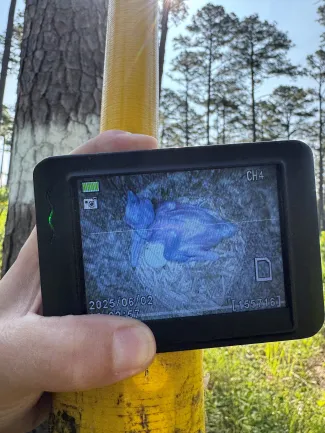
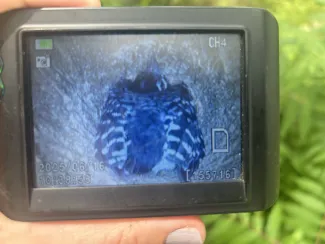
Because the Le Flore County family group is so new to the area and in such a vulnerable life stage, Howell only looked in on the cavity twice. Red-cockaded woodpecker chicks fledge 26-29 days after hatching, and the Le Flore County chick is thought to have left the nest days after Howell’s second check.
To help the new family group get a more solid footing, Howell plans to return to the area with Wildlife Department biologists in August to fit man-made nest boxes into nearby trees, giving the female and chick a safer place to spend the night and avoid potential predators.
She’s looking forward to continuing the management partnerships between the different agencies and states.
“The habitat work we’re doing on Oklahoma’s Le Flore Unit is giving the Arkansas birds a better expansion corridor into Oklahoma. And partnering to manage and monitor this new territory across state and agency boundaries, including any potential future translocations of birds, will only strengthen our efforts,” Howell said. “We’re all in this together.”