Whether you know them casually as a “red bird,” “blue bird,” and “black bird,” or more formally as a “northern cardinal,” “blue jay,” and “American crow,” you’re welcome at nature’s observation deck known as bird watching. As with most hobbies, bird watching interests and skill levels can vary, as can investments in time and resources. And each birder can chart their own course; building, maintaining, or leveling up their skills as life allows. The one constant? There’s almost always a bird to watch.
Take our bird watching quiz to find your birding style, then get tips for building skills and leveling up your birding experience.
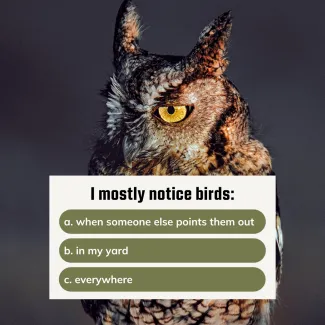
📷 Eastern screech-owl by Duncan Brittain
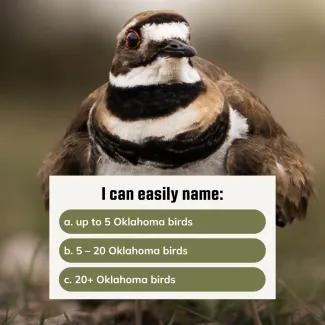
📷 Killdeer by Peyton Cole
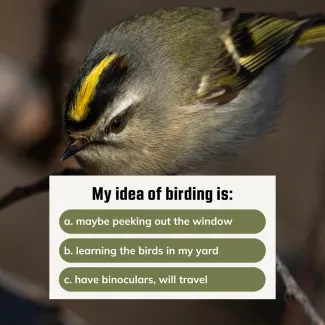
📷 Golden-crowned kinglet by Stephen Ofsthun
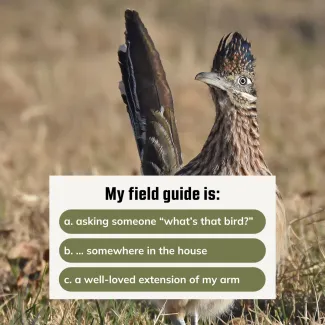
📷Greater roadrunner by Sherman Barr
Bird Watching Quiz Results
- I answered mostly "a."
You’re a Fledgling Birder!
Welcome to the world of birding! Oklahoma has a great mix of birds that remain in the state year-round as well as those that only summer, winter, or pass through each year, making the state an epic place to begin your bird watching journey.
Getting Started: You won’t need much for this hobby’s initial flight. Binoculars and a field guide can help (both can be found on the cheap at yard sales and discount sites) but the real trick is to start noticing birds and paying attention to things like their size, shape, color, and behavior. These small details can help narrow the list of possibilities and are the building blocks for nearly all bird identifications.
Birds to Look For: Northern cardinal, blue jay, American crow, American robin
How to Level Up: Consider investing in a field guide and committing to learning more about the birds that interest you or that you see in your everyday life. If you’re driven by goals, try to learn 5-10 birds a year. If that’s not your thing, try browsing free resources like the Cornell Lab of Ornithology’s All About Birds website, drawing a bird you see regularly, or cultivating friendships with other bird nerds.
- I answered mostly "b."
You’re a Yard Bird!
Home is where you build your nest, and where your bird watching hobby can really settle in and get comfortable. As a yard bird, you can simply enjoy watching the birds that visit; focus on adding sources of food, water, and cover (a.k.a. habitat) for the birds to use; or make the most of your chance to build and practice bird identification skills day after day.
Getting Started: Once you start paying attention to birds and mentally cataloging their size, shape, color, and behavior, you’ll probably find yourself staring out the window more, waiting to see your next bird. In addition to putting in your time at the window or on the porch, thumb through a field guide every few weeks to get more familiar with the book (or website) and the birds that may visit your yard. If you have binoculars, practice bringing them to your eyes without taking your attention off a specific leaf … or fork in a tree branch … or trash can. Birds won’t always sit still and learning how to find what you wanted a closer look at through the binoculars can take a little time and muscle memory. If you’re interested in bringing birds closer — either for enjoyment or for getting a better look at the field marks — a bribe in the shape of a bird feeder can help.
Birds to Look For: Carolina chickadee, northern mockingbird, eastern bluebird, brown thrasher
How to Level Up: If you’re comfortable identifying the birds that visit your yard — or you’re just ready to see a different set of birds — consider making a birding trek to a neighborhood park or driving a back road where you can safely pull off and watch for birds from the vehicle. (If you’re using binoculars in a populated area, remember to be courteous of other’s privacy.) If you’re not an outings kind of person, consider turning your yard into a wildscape that will attract even more birds and wildlife!
- I answered mostly “c.”
You’re a Long-distance Migrant!
Your birding hobby is going the distance. You notice and identify birds in your yard, the grocery store parking lot, and sometimes even in your dreams. When you see a Carolina chickadee, your verbal call-back of “chickadee-dee-dee” is instinctive and automatic. And your friends and family have learned the best way to engage you in conversation is to lead with “I saw this bird…” but know your attention may fly away as soon as a bird swoops into your field of view.
Getting Started: At this point in your birding journey, you can probably open your field guide to the right section and have a birding app open on your phone. If you haven’t already invested in a decent pair of binoculars, it may be time to start shopping around for optics or setting up a sinking fund for a pair in your budget (a solid pair of 10X42 binoculars can run between $100 – $300 while higher end models can start at $2,000). As your birding skills continue to improve, consider taking them on the road. Visiting eBird hotspots, state parks, and Wildlife Management Areas can challenge your skills and help build your bird list.
Birds to Look for: Any and all, including the American avocet, northern harrier, blue-gray gnatcatcher, and white-crowned sparrow.
How to Level Up: Sharing your bird brain — either by mentoring other birders or logging your sightings on nature sharing platforms like eBird or iNaturalist — is a great way to take your birding experience to the next level. Documenting the specific what, when, and where details can help you remember the birds you’ve seen … help fellow naturalists plan their next adventure … and help biologists design their next survey or study.
Remember, no matter what style of birder you might be, birding requires regular practice and homework. Without those, your hard-earned kills could begin to soar away.