
Some say a bad day of fishing beats a good day working. It’s a little more complicated for U.S. Fish and Wildlife Service’s Krissy Sardina and Bureau of Indian Affairs WaterCorps AmeriCorps members Chuck Taylor and Bradley Gooch. For this invasive carp early detection crew, not catching their target fish is a very good day at work.
The trio have been monitoring the Red River downstream of Denison Dam to learn more about the movements of adult invasive carp and conducting early detection sampling for carp larvae. They’re currently tracking about 88 adult carp, including silver or "jumping" carp, and have yet to document larval invasive carp in this river system.
“That would be a worse-case scenario — getting a larval fish,” said Sardina. “Once you start seeing larval fish in a river system, especially carp, their populations tend to explode. It’s one thing to have a slow migration of adults. It’s another to have millions of fry that are growing into adulthood and getting established in that location.”
Something Wickedly Invasive This Way Comes
Oklahoma is still in the early pages of the ecological horror story that is invasive carp. Though multiple carp species have been introduced in the United States since the 1800s, three species have been making headlines in recent decades with their outsized impact to river systems and native fish communities. Bighead and silver carp, collectively known as bigheaded carp, were originally brought to the United States in the 1970s to control algae growth in aquaculture facilities and sewage ponds. (Silver carp are especially known for jumping from the water when startled and have become a bizarre risk to anglers and boaters.) Black carp were unintentionally brought over in grass carp shipments around that time and later intentionally imported to control snails and grubs in aquaculture farms. Over the next 20 years, flood events led to escapement from facilities and the fish quickly settled in the lower Mississippi River. They’ve since become known for their ability to invade and have moved into several major tributaries in the Mississippi and Great Lakes basins where they consume river-loads of plankton and other foods and, in some states, have outcompeted native fish communities.
“The Red River is like a turnpike,” said Chuck Taylor. “A turnpike doesn’t have very many turnoffs. These fish just jump on the turnpike, come upriver, and exit whenever they can.”
For the carp, these turnpikes are best traveled when high flows fill the banks and connect the sometimes braided and shallow rivers. They’ll swim against the powerful current to potentially spawn and expand their range and use slower moving tributaries as exit ramps. The adult fish can either move back downriver as flood waters recede, or find new homes in the slower, deeper sections of the tributaries.
Bighead carp have been documented in Oklahoma’s Neosho and Grand rivers above and below Grand Lake, as well as Lake Hudson, the Red River below Lake Texoma, and the Kiamichi River below Hugo Lake. Silver carp have been found in Oklahoma’s Arkansas and Red rivers. And Oklahoma’s first confirmed black carp, an adult fish caught in a private pond, was recently reported in McCurtain County.
The Red River can be a harsh place for fish to eek out a living. In addition to its naturally high salinity levels, the flood-prone river can swing from depths of less than five feet to more than 30 feet. Native fish are long adapted to these flood pulses, and many species align their breeding season with spring rains. When seasonal flows increase, fish swim upstream to spawn and the current carries the developing eggs downriver. Invasive carp follow a similar strategy in their home waters, as well as in the United States.
“There have been studies that show invasive carp can spawn within 40 river miles,” Sardina said. “It seems like the more they watch these fish, the shorter distance it may take.”
Maybe more important than the length of river the eggs can float in the current and not touch the bottom is water temperature. Invasive carp eggs may develop in as little as 18 hours in warmer temperatures. In cooler water temperatures of about 65 degrees, the eggs may take as long as 80 hours to hatch and become larval fish, or fry.
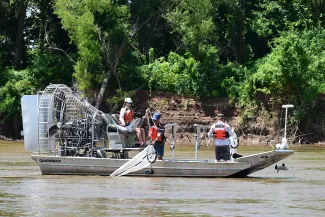
The USFWS’s invasive carp early detection crew has been watching the river for these floating eggs and larvae, launching their boat as soon as flood waters begin to rise.
“Safety is always our first concern,” Sardina said. “Our crew has extensive experience working in high water conditions and our equipment is tailored for it.”
They stage downriver from where adult fish are known to have been and collect samples from each bankside as well as mid-channel, focusing on pockets of water at least 5 – 7 feet deep. When the team arrives at their sampling site, they deploy two 6.5-foot-long mesh funnel nets with a collection container at the end of the funnel. The nets are towed upriver at the boat’s sides for four minutes at the speed of the current; one net is towed at the top of the water column, the other collects a sample from about halfway down.

After four minutes, the nets and collection containers are brought back into the boat. Sardina, Taylor, and Gooch visually inspect the samples, briefly sorting through any large debris picked up during the tow for tiny eggs and larvae the size of an eyelash. After this field scan, the samples are preserved with notes about the river conditions and water quality metrics.
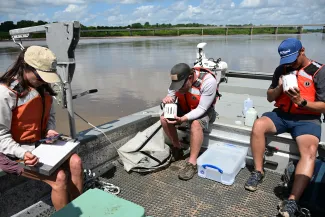
“One sample can take 40 – 80 man hours of time to separate fish from debris,” Sardina said. “We quickly figured out that was not going to work.”
Instead, they test each sample for environmental DNA, or eDNA, and prioritize samples that have a high number of invasive carp DNA copies for further examination.
“We can take a subsample of alcohol that’s in those samples and test it for eDNA. That tells us the number of target copies of DNA from the fish that we’re looking for. We might get a few copies if an adult fish was swimming by the boat and shed a few scales. But if we’re seeing 10,000 copies, 20,000, 100,000 copies, it’s really likely that we’re going to have a larval fish in that sample.
“We don’t use it as a yes, no. We use it as a guide to say, OK, these samples had no eDNA. We’re not going to spend thousands of hours going through them. We’re going to focus on the ones that might have larval fish.”
Because dozens of native fish species also may have spawned around the same time as the crew’s sampling efforts, Bradley Gooch likens their visual search for “eyelash” larval invasive carp to that of “looking for a needle in a stack of needles.” To increase their chances of finding invasive carp larvae or their DNA, should they be in the river, the team returns to sites that best fit their prediction models multiple times each season and spends much of the day continuously sampling the same spot. “We treat the river like a conveyor belt,” Gooch said. If there are eggs and larval fish drifting downstream, they should eventually pass by the sampling gear. “Let ‘em come to us.”
Between prep work, deploying the nets, visually scanning the collected materials, and archiving the samples for eDNA testing, each four-minute sampling session takes about an hour of time. And while the crew is dedicated to their work and relieved to have not yet documented an invasive carp spawn in the Red River, it takes a special mindset to spend days and months on the water not catching their target fish.
“We don’t have much difficulty staying entertained on the Red,” Sardina said. “At first glance, the river can look deceptively ordinary, but it’s strikingly remote, untamed, and dynamic. No two days are ever the same.
"Learning to work on its terms has only made us feel more invested in conserving its impressive diversity of native fish, wildlife, and habitats in collaboration with partnering agencies.”
Gooch agrees. “Chuck and I are both Chickasaw and both locals, born and raised. The biggest thing is that we care about the river, and Oklahoma as a whole.”
Got carp? If you haul in a bighead, silver, or black carp, be sure to report your catch at wildlifedepartment.com. Anglers also can help slow the spread of these invasive fish by avoiding cast-netting waters where invasive carp are known to occur. Young invasive carp are difficult to distinguish from some native fish and have been transported to new waterbodies inadvertently when used as bait.