Each year, the Oklahoma Department of Wildlife Conservation (ODWC) funds numerous research projects across the state, from the effects of weather and hunting on Northern bobwhite populations to the efficacy of trout stocking. Mule deer population evaluations are no exception.
These efforts are part of a broader commitment to data-driven wildlife management that connects research findings directly to long-term conservation practices and goals. ODWC supports the continuous understanding of Oklahoma’s wildlife that assists scientists, landowners, the communities, and beyond in managing for healthy wildlife populations. Universities serve as vital partners in the journey to understand more about species’ status and to provide data for informed decision making to improve management and population viability.
Summer rolls in through the great plains of Oklahoma, starting another field season for Oklahoma State University (OSU) Ph.D. student, Molly Koeck (Chitwood Lab), studying mule deer. These mammals are presumed to have low density across their limited western Oklahoma habitat which contains varying food sources and harsh natural weather occurrences. Under ODWC laws and regulations, mule deer share the same harvest regulations as white-tailed deer but require more data for harvest management, population ecology, and distribution as they are on the emergent extent of their known species range. Mule deer are an understudied species in Oklahoma with unknown population dynamics, striking the interests of wildlife professionals to find solutions for mule deer management and help ODWC “effectively manage harvest, adopt long-term monitoring, and prioritize habitat management.”
Wandering across western Oklahoma through vast waves of grasslands and arid mesas, curious mule deer peek out their heads with large, mule-like ears perking up. Seen in the groups studied here, they have a smoky brown-gray coat with a cream-colored rump and snout along with highlights of baked brown across its limbs. Unlike the other deer species seen in the state—the iconic and prized white-tailed deer—that have pelage or fur colors of a more orange-brown take, western Oklahoma mule deer are larger in size with bifurcated antlers. By observing the length of the tarsal gland, hybridization can be noted with white-tailed deer in areas of sympatry, also referred to as an overlap of species’ distribution in the same area, located in the Great Plains and western OK with white-tailed deer being more eastern adapted. Both species can be seen in similar biomes (a large area with similar climate, plants, and animals), but mule deer seem to prefer more rocky environments and white-tailed deer forested areas. The behavior term “stotting” is exercised by mule deer when bouncing away on all four feet and is not commonly observed in white-tailed deer. According to the OSU research team, an encounter with a mule deer in western Oklahoma tends to end in the deer standing tall watching the observer for longer periods of time rather than immediately fleeing as white-tailed deer do.
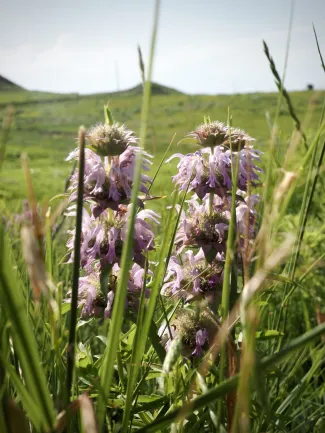
The mule deer research team, consisting researchers at OSU and Texas A&M University-Kingsville and the Ceaser Kleburg Wildlife Research Institute has taken on this three-year project with determination. Data collection began in the year 2024, continuing through 2026 and to be concluded with a complete analysis and a final report for ODWC in 2027. Koeck and her field crew have many full days of research, from placing tracking collars on the deer to conducting vegetation surveys across the grasslands, which are flooded with wildflowers in early summer.
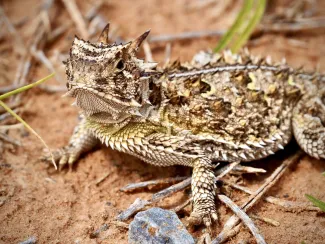
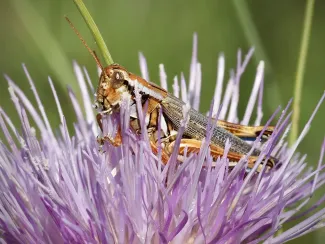
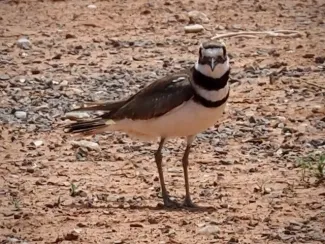
They also get to enjoy the plentiful biodiversity of Oklahoma like the horned lizards that scamper across their path, protective killdeer parents giving their best “broken wing” display, and varieties of grasshoppers making leaps and bounds among the tall grass. By assessing the surrounding factors that contribute to mule deer distribution, abundance, survival rates, and habitat/resource selection, with consideration of increasing anthropogenic pressures, ODWC stands to gain a better understanding of the population as a whole. This will assist in facilitating sustainable, long-term management of the species.
During the summer research season, mule deer movement patterns are monitored for spatial clustering each day thanks to GPS radio-collars which have been deployed to focus the information on fawns. Alerts of birth events are emitted from the vaginal implant transmitters (VIT) placed in collared and pregnant individuals the previous winter. These VITs have both a light and temperature sensor that will activate when expelled during the birth of a fawn. To allow for maternal bonding time, Koeck and her team wait for a minimum of four hours before tracking down the mother deer by foot.

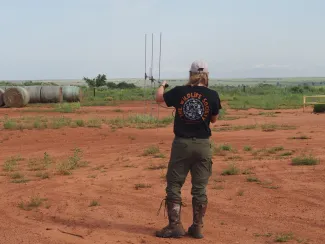
Locating the collared doe and expelled VIT via very high frequency (VHF) signal is the first step in a fawn search to ultimately hone in on a birth-site. Using a 3-element handheld folding Yagi antenna connected to a TR-8 receiver by a coax cable, radio telemetry takes the lead in locating the equipment. The VHF frequency is converted to an audible frequency adjusted for the human ear once the receiver successfully picks up the targeted VHF frequency. The attached Yagi antenna comes in to pick up the signal at greater distances and indicates a direction for the team to trail. Two practices, usually in conjunction, are utilized to locate the VHF device: “triangulation” and “honing”. Triangulation refers to scouting out multiple areas to search and listen for the signal to gauge a more specific location, and honing is the action of moving in on and locating the device typically by foot.
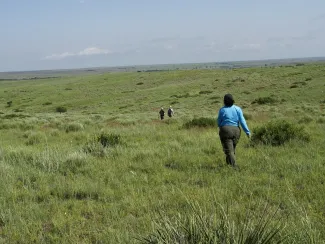
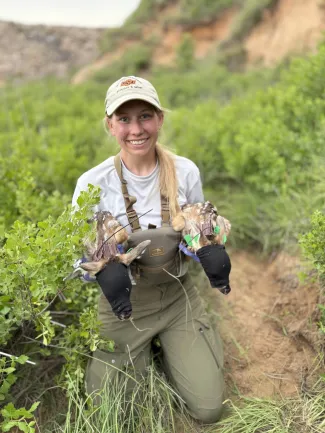
After seeking out the doe, the crew spooks the adult, and grid searches the surroundings for the fawns. Fawns upon sighting are then blindfolded to reduce visual stimulation and triggers and handled within 15 minutes to reduce stress in preparation for the data collection process. Personal Protective Equipment (PPE) wear like long-sleeves and nitrile gloves are worn by the team to avoid direct contact or scent transfer. Weighing, application of ear tags, and collection of body measurements, hair samples, sex, genetic tissue via ear biopsies, and age (through umbilicus and hoof characteristics within hours) are assessed. A VHF collar is also placed on the fawn that can communicate to the maternal doe’s collar using Neolink technology similar to Bluetooth. After the researchers have completed all of these steps, the fawns are released in the same location where they were encountered, and their survival is observed throughout the summer with any signs of mortality received through the mother deer’s collar.
Late wintertime calls for the combined efforts of a helicopter and a net-gun to capture adult mule deer—male and female—for the project. Koeck’s team contacts an experienced helicopter crew lined up with a pilot, gunner, and mugger. As they hover across the land, the pilot lays eyes on a deer and closes in for the gunner to shoot the net gun, no tranquilization needed. The mugger takes actions by blindfolding and hog tying the deer after it is down within minutes. The secured deer is then slung or put in a sac to be flown back to a central processing site located about three or so miles away from the capture location for the research team to receive and begin data collection.
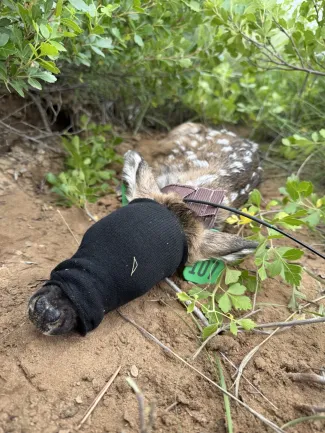
The same measurements as the fawns are collected for the adult mule deer wearing PPE with the addition of collecting blood, ectoparasites like ticks, fecal, and salivary samples. Fat deposition and nutritional conditions are determined by using ultrasonography to take measurements of rump fat thickness and by feeling the deer along the spine and rump, thus finding out how bony it is, one is able to estimate body condition scores. Ultrasonography used for the does help in checking for pregnancy status and if the individual checks the box for being considered pregnant, a VIT is placed to help in neonate detection at a birth event happening. All adult deer are tagged used ear tags and fitted with a GPS/VHF collar. For identification of recaptures that have already been through the process, the deer are also spray painted on their dorsal side for the helicopter crew to notice during a flight. The deer are finally released at the central processing site following the completion of data collection and identification process. All animals are handled with care and the researchers involved have an Institutional Animal Care and Use Committee (IACUC) approved protocol, a required document application listing the use of living vertebrates in research and teaching by law.
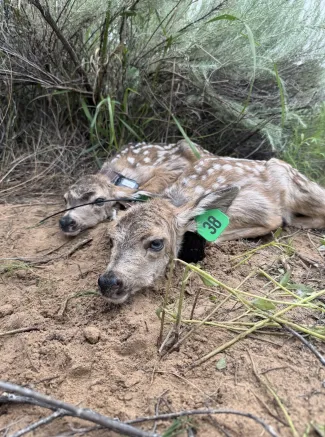
By collecting this information from both the fawns and the adult bucks and does, a complete picture of the population including health, distribution numbers, environmental conditions, and more on mule deer status can be painted and framed. Data from blood samples can scan the deer for disease and mineral testing, and salivary samples as well as hair are used for cortisol testing, giving researchers a good look into the deer’s physical health. Tracking their movement and distribution as well as birth and mortality influencing factors aid in providing information on vital rates. Having more knowledge on their varying environmental selections including any anthropogenic features like agriculture or harvest scenarios can also help aid in their population management. Altogether, this comprehensive data empowers wildlife managers like ODWC to make informed, science-based decisions that support sustainable mule deer populations now and into the future.
“It is a privilege to document the behavior, abundance, and survival of a population occurring at the extent of the species' current range,” says Koeck. “The information we provide will be invaluable in managing a population that determines the limit of mule deer range, and the monitoring foundation we're creating can be used to evaluate future range contractions or expansions.”