A common practice that many landowners tend to overuse is mowing or brush hogging. While mowing can achieve an aesthetically pleasing look to a property, mowing does not achieve the objectives that most landowners are trying to accomplish by using this practice. In fact, with wildlife management as a main focus for a property, widespread mowing removes vital habitat for nesting, bedding, and forage. Targeted and intentional mowing can be useful for accomplishing goals, while non-discretional and ill-timed mowing generally causes more harm than good.
Brush Management
Many landowners depend solely on mowing to manage brush encroachment in their open areas. Mowing through thickets of woody species like winged elms, locusts, immature oaks, shinnery oaks, mesquite, plums, and blackberries is commonly done to attempt to control the size and prevalence of these thickets. However, while mowing does knock the plants back down to ground level, their elaborate root systems remain intact and very much alive underground. In fact, as a response to mowing, the root systems of these plants will send up as many or more re-sprouts as a survival response, so the act of mowing most often only exacerbates the problem of excessive brush.
When managing for wildlife, 15-30 percent coverage of brushy structure is actually necessary in providing habitat aspects like browse, thermal cover, escape cover, nesting, bedding, and even perches for songbirds. For wildlife, the best option instead of mowing is to manage brush using prescribed fire – “top killing” the portion of the plant above ground but then allowing it to resprout, repeating this cycle every two to three years so the plants are kept low to the ground (two to five feet tall) and remain accessible to wildlife. If the woody brush component begins to exceed 30 percent, the proper way to treat is either to use chemical applications on smaller areas of minimal encroachment, or, on larger thickets, mowing can be used in order to gain better access followed by a foliar chemical application once the plants re-sprout.
Weed Control
Similarly, another beneficial use of mowing is to help control introduced invasive herbaceous plants. For the purpose of weed control, mowing should be used in conjunction with chemical applications and prescribed fire. For example, heavy stands of sericea lespedeza can be sprayed, then mowed, then burned, repeating this cycle at least once per year.
Strip Mowing
A good use of a tractor and brush hog is to create foraging strips for game and nongame birds. By mowing several strips within a pasture through stands of desirable seed-producing forbs, like sunflowers and crotons, this provides birds easier access to the seeds by putting them directly on the ground. Doves especially take advantage of these shredded strips, and the short vegetation allows for better visual during dove hunting. Pheasants and turkey will use these lanes for brooding as well, while songbirds use them mainly for the foraging opportunity. These lanes should be mowed during August, leaving about six to eight inches of plant stubble standing, and keeping the lanes relatively narrow, between 20 and 30 feet wide.
Access Routes and Firebreaks
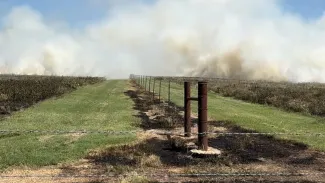
Mowing can and should be used (if practical in a conducive soil type) to create and maintain routes that allow you to access your property, including interior roads and fence lines. Mowing is also encouraged to maintain constructed firebreaks. General access routes can be maintained at your desired width. Constructed firebreaks should be mowed at a minimum of 12 to 15 feet wide, but generally don’t need to exceed 30 feet, unless otherwise prescribed. Mowing these paths at least twice per year helps minimize woody plant encroachment and keeps these important routes accessible and ready for use.
The use of mowing, while it can be beneficial and necessary to achieve certain objectives, should be intentional, targeted and should overall be done sparingly. Other, more effective methods should be used in place of mowing to accomplish objectives like weed management, brush control, and aesthetics.
If you are interested in taking on some wildlife habitat management work on your property, and would like some input on the best approaches, reach out to the Oklahoma Department of Wildlife Conservation’s private lands biologist in your area.