
Have you ever heard that the daddy longlegs is the most venomous spider in the world, but its fangs are just too short to bite a person? Sorry to burst your bubble, but the claim is an urban legend and isn’t true.
In fact, the daddy longlegs is actually no spider at all. And it’s not even venomous!
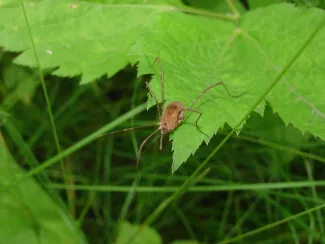
Contrary to popular belief, the daddy longlegs (order Opiliones) is not a true spider, but it is related. A spider is an arachnid that has eight legs, eight eyes, two body segments, and spinnerets that produce webs. The only physical feature the daddy longlegs has in common with a spider is its eight noticeably long legs.
In reality, the daddy longlegs is a distant relative of spiders. It is classified as an arachnid, but it is more closely related to scorpions, mites and ticks.
This arachnid can be identified by its very long and thin legs, single oval body segment, and two eyes. It has an average body length of 5/16 of an inch, but including the long legs can give the creature a diameter of 6 inches.
Another misconception is that this arachnid’s true name is daddy longlegs. But its actual name is harvestmen. The name originated from the fact that these creatures are mostly seen in late summer and early fall, which is traditionally considered harvest time. Hence the name harvestmen.
Daddy longlegs are typically solitary except when they congregate in large, unsightly groups in fall. They generally do not display social behaviors or aggression toward other daddy longlegs.
When predators threaten, the arachnid must defend itself. The daddy longlegs has three methods of defense. The first is to produce an unpleasant odor from glands called ozopores. This odor smells awful to predators, and they usually back off. But if that doesn’t work, the arachnid will deploy a strategy called thanatosis, wherein the daddy longlegs plays dead and attempts to fool the predator. It will do this for several minutes.
If the predator remains persistent, the daddy longlegs will then drop off one of its legs. The unattached leg will continue to twitch and move, which can confuse or frighten the predator long enough for the daddy longlegs to escape. Unfortunately, after using this tactic, the leg won’t regrow. It’s common to find these creatures with a missing appendage or two.
For sustenance, harvestmen forage at night for small insects, worms and decaying organic matter.
Keep an eye out and you might find a daddy longlegs in damp, dark spots such as a garage, under rocks or leaf litter, and on the shady side of brick buildings or trees. Daddy longlegs may seem unsightly, but having them around is very beneficial — especially for gardeners, as they do feed on garden and other agricultural pests.