
Description
** INVASIVE! **
Freshwater jellyfish (Craspedacusta sowerbii) are native to the Yangtze River valley in China. They were most likely introduced to the United States with ornamental aquatic plants, especially water hyacinth, from its native region in China. Within the US, they can be translocated accidentally with stocked fish and aquatic plants, or by waterfowl. They were first reported in the US in 1880 and have since been recorded in 44 states.
Habitat
In areas where freshwater jellyfish have been introduced, they typically inhabit shallow, slow moving or bodies of water, ranging between 50 and 90 degrees Fahrenheit. Studies have shown that higher turbidity or increase in color of the water would provide more favorable conditions for the invasion process of this hydroid. Polyps are able to camouflage themselves by secreting a sticky mucous that adheres particles to their body. They are opportunistic predators, feeding mostly on zooplankton that come within its reach.
Life Cycle
Freshwater jellyfish were first reported in Oklahoma in 1930. Recorded locations include Elmer Thomas, Stroud Lake, Tenkiller, Grand Lake, Texoma, Wetumka, Broken Bow Reservoir, Robert S. Kerr, as well as in the Muddy Boggy and Little River.
The impact of this jellyfish currently remains unclear. However, studies have shown that their preference to zooplankton has the potential to influence relative zooplankton species structure (a crucial food source for native juvenile fish as well as paddlefish). A study in the 1970s found evidence that they may also consume fish larvae and eggs, but they are generally not considered an important predator of fish at these stages.
Freshwater jellyfish are not considered dangerous to humans. Although its stings can paralyze macroinvertebrates and small fish, its small nematocysts are not likely to penetrate human skin.
How To Observe
Key Identification
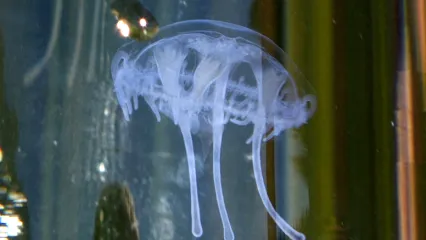
- Most easily identified when it takes the form of a small, bell-shaped jellyfish (known as a hydromedusa)
- 5-25 mm in diameter
- Translucent with a slightly white or green tinge
- Tentacles are varying lengths, arranged with three to seven short tentacles located between four longer ones
If you think you have discovered any invasive species contact us at (918) 200-4815 or report online.