
Sweet spring is here, bringing with it an epic playlist of more than 200 bird species that breed in Oklahoma. Learning to recognize these avian vocalists by their signature sounds, tempos, and lyrics (also known as birding by ear) is a great way to level up your nature experience and appreciate birds — and the challenges of birding — in a new way.
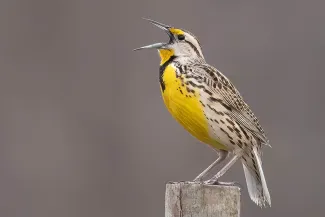
“You won’t always see a bird or get a great look at its identifying field marks, but you might just hear it,” said Kelly Boyer, a communication and education specialist with the Wildlife Department. “Each bird species has a unique voice. Learning their songs, calls, chirps, and trills can be a fun new way to identify birds. It can also impress and annoy your friends!”
To train your ear, Boyer recommends starting with the birds you regularly encounter. Backyard birds like the blue jay, Northern mockingbird, American crow, red-bellied woodpecker, and Northern cardinal are often common enough and vocal enough for birdwatchers to start connecting those species to their respective sounds.
“You may already know what a northern cardinal looks like, but if you’ve never paid attention to the sounds it makes, you may be in for a fun surprise,” Boyer said. “When I hear a cardinal singing, I envision a laser gun in a video game: ‘pew, pew, pew’ 🔊.”
Once you’ve listened to your backyard bird visitors and are familiar with their sounds, slowly branch out to other birds you hear singing or try learning the songs of your favorite species. Apps like eBird and Merlin can serve as great references (more on the magic of Merlin later) as can printed field guides and online resources like the Cornell Lab of Ornithology’s All About Birds website. Other birders in your area or those on social media may hear slightly different lyrics or have more memorable tricks, so connecting with the larger birding community can also help train your ear and grow your bird list.
BIRDING BY EAR: Ten Popular Mnemonics
Learning bird sounds can be tough. These mnemonic devices have helped many birders isolate one vocalist in nature's massive playlist and learn to recognize birds by ear.
Barred owl 🔊 Many may think all owls give a “hoot,” but the barred owl has quite the vocal repertoire. If you’re in a wooded area at night (or even on a cloudy day) listen for their lyrical “who cooks for you, who cooks for you all” call. Mated pairs will also perform raucous duets in late winter and early spring.
Tufted titmouse 🔊 This little bird may be muted in color but it’s not afraid to turn up the volume — in voice or body language. In addition to their quickly repeated song of ”Peter, Peter, Peter,” titmice will also give scolding calls when disturbed.
Summer tanager 🔊 Despite their bright colors (males are strawberry red; females are mustard yellow) a quiet summer tanager can be a challenge to spot when perched among the leaves. Luckily, males readily sing from an exposed branch, and both sexes give ”pity-tut-tut” calls.
American goldfinch 🔊 These feeder favorites can be easily recognized by their bright yellow breeding plumage as well as their “potato chip” flight call. Goldfinches have other vocalizations, but the flight call is most frequently used and helps keep the flock intact.
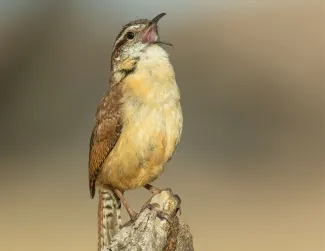
Carolina wren 🔊 With a bullhorn for a bill, the Carolina wren has no problem shouting “TEAKETTLE, TEAKETTLE, TEAKETTLE” into the forest. (Depending on your hunger-ometer, it may sound like this feisty bird is saying “cheeseburger, cheeseburger, cheeseburger.”) Pairs stay together year-round and females may give a rattle call when dueting with males.
Common yellowthroat 🔊 A trip to a wetland may be needed to listen for this masked warbler’s tell-tale “witchity, witchity” song. Males sing to attract females and defend territories, sometimes performing 125 songs per hour.
White-throated sparrow 🔊 These handsome sparrows may not nest in Oklahoma, but can still be heard singing “Oh-sweet-canada-canada” in winter months and throughout their migration.
Northern yellow warbler 🔊 If you’re a tiny ball of bright yellow fluff, sometimes you just have to say “sweet, sweet, sweet, I’m so sweet.” These Neotropical migrants are most associated with streams and wetlands.
Great crested flycatcher 🔊 This flycatcher is more easily heard than seen as it nests in cavities and often hunts for insects high in the canopy. Listen for the distinctive “WHEEP” call in open woodlands across much of the body of the state.
Indigo Bunting 🔊 If this bird’s electric blue feathers don’t catch your eye, its repeating song of paired notes might catch your ear. Listen for “fire fire, where where, here here” spring through fall.
BIRDING BY PHONE: The Magic of Merlin
In 2020, the Cornell Lab of Ornithology began training cell phones to identify bird calls … or more truthfully, it began training an algorithm to recognize images of audio recordings — or spectrograms — of individual bird songs and calls. After dozens of clean recordings had been annotated for each species, the algorithm was added to the Lab’s existing Merlin Bird ID app, which has become something of a birding mentor for millions of users. With only a few taps, the app can suggest bird identifications based on a general description, photo, or audio recording.
As tempting as it may be, don’t phone in your birding experience by turning this magical mentor into a birding genie that lives with your pocket lint and identifies birds on your command. If you aren’t hearing impaired, watch the spectrogram as the app is actively recording and suggesting an identification, pinpoint the direction from which your target bird is calling, and try to physically find and watch the bird. Or replay your sound recordings and try to mimic the call or create your own mnemonic device — or even hand gestures — that can help you remember the cadence of the bird’s song. If your hearing is limited, Merlin’s Sound ID can still help you watch birds that may be in your general vicinity. Knowing which birds are calling loud enough to be detected by your phone can help narrow your search image or let you focus on your target bird’s preferred microhabitats.
BIRDING BY EAR BONUS: Birds That Say Their Name
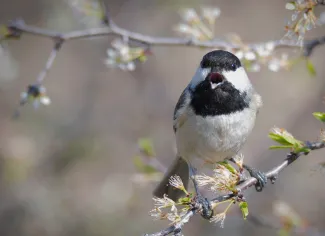
Carolina chickadee 🔊 Only one chickadee, the Carolina chickadee, is found in Oklahoma. And while the small, acrobatic, black, gray, and white bird has a four-note song, its call is a rapid “chickadee-dee-dee-dee.”
Eastern phoebe 🔊 Soon after arriving in Oklahoma in early spring, male eastern phoebes begin singing their two-part song, “fee-bee.” In the eastern half of the state, the phoebe’s song may overlap with that of a related flycatcher, the eastern wood-pewee 🔊. After singing “pee-a-wee,” the wood-pewee often adds a comical, down-turned “pee-a-you” to the end of the song.
Northern bobwhite 🔊 Many Oklahomans delight in hearing what could have been named the state bird, the northern bobwhite. The ringing “BOB-WHITE” is typically sung by males in search of a mate, but females have also been documented whistling the tune.
Eastern whip-poor-will 🔊 Most people are familiar (or think they’re familiar) with the whip-poor-will’s chanting song, “WHIP-poor-WILL.” These heavily camouflaged birds may sing for hours throughout spring and summer nights. Birder Beware: The song of the chuck-will’s-widow 🔊 closely resembles that of the whip-poor-will. To distinguish the birds, listen carefully to which syllables are emphasized. The first syllable of the more common and widespread chuck-will’s-widow is typically quieter and may not be heard from a distance, “chuck-WILL’S-WIDOW”.
Blue jay 🔊 As if its bright colors and bold behavior weren’t identification clues enough, the blue jay has a tendency to repeatedly call its name: “Jay, jay, jay.” Surprisingly, the boisterous bird has a much softer “whisper song” of muddled clicks, whirs, and whines. Birder Beware: In addition to the screaming calls and whispered songs, blue jays are also talented mimics that specialize in imitating red-shouldered hawk calls 🔊.
Birding by ear can be a great way to level up your nature experience and appreciate birds in a new way. But one boy has taken this skill to the max and can sound like a bird. Actually, he is able to sound like about 60 different types of birds. Outdoor Oklahoma brings you this bird enthusiast’s fun journey from school talent show star to Good Morning America celebrity guest!