
This chapter covers some basic fishing techniques that will help you land your first fish. There are hundreds of different fishing techniques, and it takes years of experience for any angler to master them.
Spincast Fishing
While many think of fishing from a boat, the majority of anglers will start off fishing from a dock or shore. One of the simplest fishing rigs to use is a spincast rod and reel, with a small hook, split shot weight and a bobber. When used with live bait, typically a worm, this method is guaranteed to bring success if fish are present and biting.
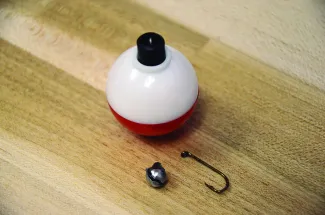
For this method, place a small split shot weight on your line to provide weight that will keep your bait submerged. The hook is typically below the weight and holds your bait. The bobber helps suspend your bait in the water so fish can see it. You can also adjust the bobber up and down your line to adjust the depth of your bait in the water.
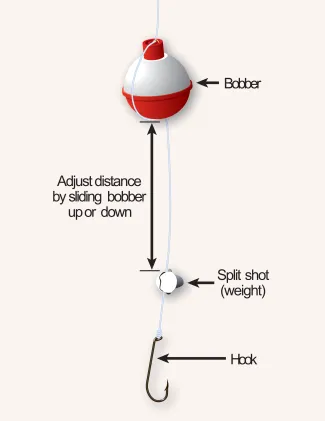
The bobber also acts as an indicator when a fish is on your hook. When the bobber goes underwater, you have a fish on the hook. For best results, it is recommended that you “set the hook” before you start reeling in your fish. To do that, simply jerk the rod tip up quickly, but not too hard or you could pull the hook out of the fish’s mouth.
Once you have set the hook, you can reel in the fish, but be sure to keep the rod tip pointed up. This will allow the rod to reduce the strain on the line so that it doesn’t break.
Eventually you will see your fish coming up to the water’s surface. Be careful not to jerk the fish out of the water but to gently pull it up. For larger fish, using a dip net to pick up the fish is recommended.
Where to Fish
One of the first things to do is decide where you want to go fishing. Finding a body of water close to home is more convenient, but
there are many places to go fishing all across the state!
Once you have picked a place to go fish, you’ll want to fish near overhanging branches, structure in the water, points, and drop-offs.
Remember to always obtain landowner permission when fishing private ponds.
Where are the Fish
Fish don’t just randomly swim around in the water. There are places they prefer to be. As an angler, knowing where fish prefer to be is good information to have.
Finding “structure” in the water or changes in elevation are key places to look for fish. Structure can be anything such as a log or rocks under the water. Downed trees or structure hanging over the water can also be a point of focus for fish. Fish will typically congregate around these objects for cover or shelter. A change in elevation also can be a focus point for fish, so fishing from a point or steep bank can result in success.
Some fish school together, and finding one normally means more are in the same area.
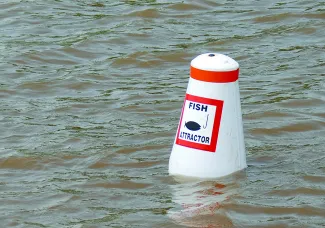
Also look for fish attractor sites. These sites are marked with small, typically orange-and-white buoys. The structure at these sites is typically man-made items or sunken cedar trees that provide cover for fish. These sites concentrate fish for anglers.
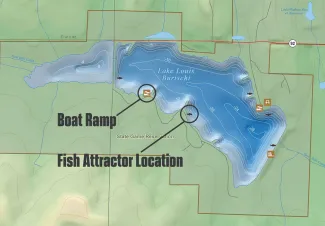
Maps are a useful tool for any angler to find places where fish might be found. Maps may show contours, changes in elevation, boat ramps, or the location of fish attractors. You can find all of these resources on our website.
Other Fishing Methods
As you progress, you may want to try other methods of angling. Some require using different types of rods and reels, with different types of live bait or artificial lures. Other methods include bowfishing, juglining, noodling, limblines, and snagging.
Back to Beginning Read Next Chapter
This content originally appeared in the Wildlife Department’s "Fishing in the Schools Manual." The full PDF manual can be viewed here.